Rule 33, 34, and 36 discovery — drafted in 5 minutes flat
AI.Law drafts interrogatories, requests for production, requests for admission, and full discovery responses with objections grounded in Rule 26(b)(1) proportionality, privilege, and work product — all tailored to your specific claims, your client's facts from intake, and your jurisdiction's local rules.
Drafting workflows start on Litigator (Draft) at $299 per seat per month. See pricing
How Discovery Drafting works on a live matter
Discovery Drafting is the AI.Law tool civil litigators use for written discovery. You know the math: 25 interrogatories with subparts, 30 RFPs, and a 30-day response window. When three sets of discovery arrive the same week, you're facing 90+ individual responses that each need specific objections and substantive answers woven with your client's facts. AI.Law processes all of it in minutes — objections with proper grounds, substantive responses with client-specific facts, and privilege logs where applicable.
On a live matter it runs in 4 steps: (1) Select your matter, (2) Choose discovery type, (3) AI drafts from your case, (4) Review, edit, export. Choose the case from your dashboard. AI.Law already has your uploaded documents, complaint allegations, intake narrative, and case data ready.
Every litigator has a discovery folder full of old requests they copy from case to case. The problem: those requests weren't written for this case, these claims, or these facts. AI.Law reads your uploaded case documents — the complaint, medical records, police reports, contracts — and generates discovery that targets the actual evidence you need. Responses incorporate your client's specific facts from AI-delivered intake, with objections citing the correct grounds: overbroad, unduly burdensome, proportionality under Rule 26(b)(1), attorney-client privilege, work product doctrine, or relevance. Interrogatories drafted from your actual claims — contention interrogatories, damage interrogatories, witness identification — with subpart compliance for jurisdictions with the 25-interrogatory limit.
Full sets of interrogatory responses with specific objections and substantive answers — 5 minutes for 40+ pages. AI understands the difference between liability discovery, damages discovery, and third-party discovery. Each output cites the source pages in your matter so you can verify it before you file.
What your drafted discovery includes
AI.Law drafts complete written discovery sets — interrogatories, requests for production, and requests for admission — tailored to your specific claims, defenses, and case facts. Not templates with blanks.

- Rule 33 interrogatories targeting claim-specific facts, insurance coverage, witness identification, and expert disclosures
- Rule 34 requests for production organized by category: documents, electronically stored information, tangible things, and inspection requests
- Rule 36 requests for admission drafted to narrow trial issues — liability facts, damages amounts, and document authenticity
- Definitions and instructions section with standard terminology and production format specifications
- Proper objection-resistant drafting — single-topic requests, specific time frames, defined terms
- Proportionality-conscious scope that satisfies Rule 26(b)(1) without inviting overbreadth objections
- Claim-by-claim organization so you can trace each discovery request to the element it supports
How It Works
Get started in minutes. No training required.
1. Select your matter
Choose the case from your dashboard. AI.Law already has your uploaded documents, complaint allegations, intake narrative, and case data ready.
2. Choose discovery type
Rule 33 interrogatories, Rule 34 RFPs, Rule 36 RFAs, responses to incoming discovery, or deficiency letters — pick what you need for this stage of the case.
3. AI drafts from your case
AI reads your case documents, identifies relevant claims and facts, and generates tailored discovery. Responses include specific objections with legal grounds and substantive answers with your client's facts.
4. Review, edit, export
Review the draft, adjust scope or objection strategy, and export as a Word document formatted for your jurisdiction. Privilege log entries generated where applicable.
See Discovery Drafting in a real matter
Not a mockup — this is the actual AI.Law workspace attorneys use on live cases.
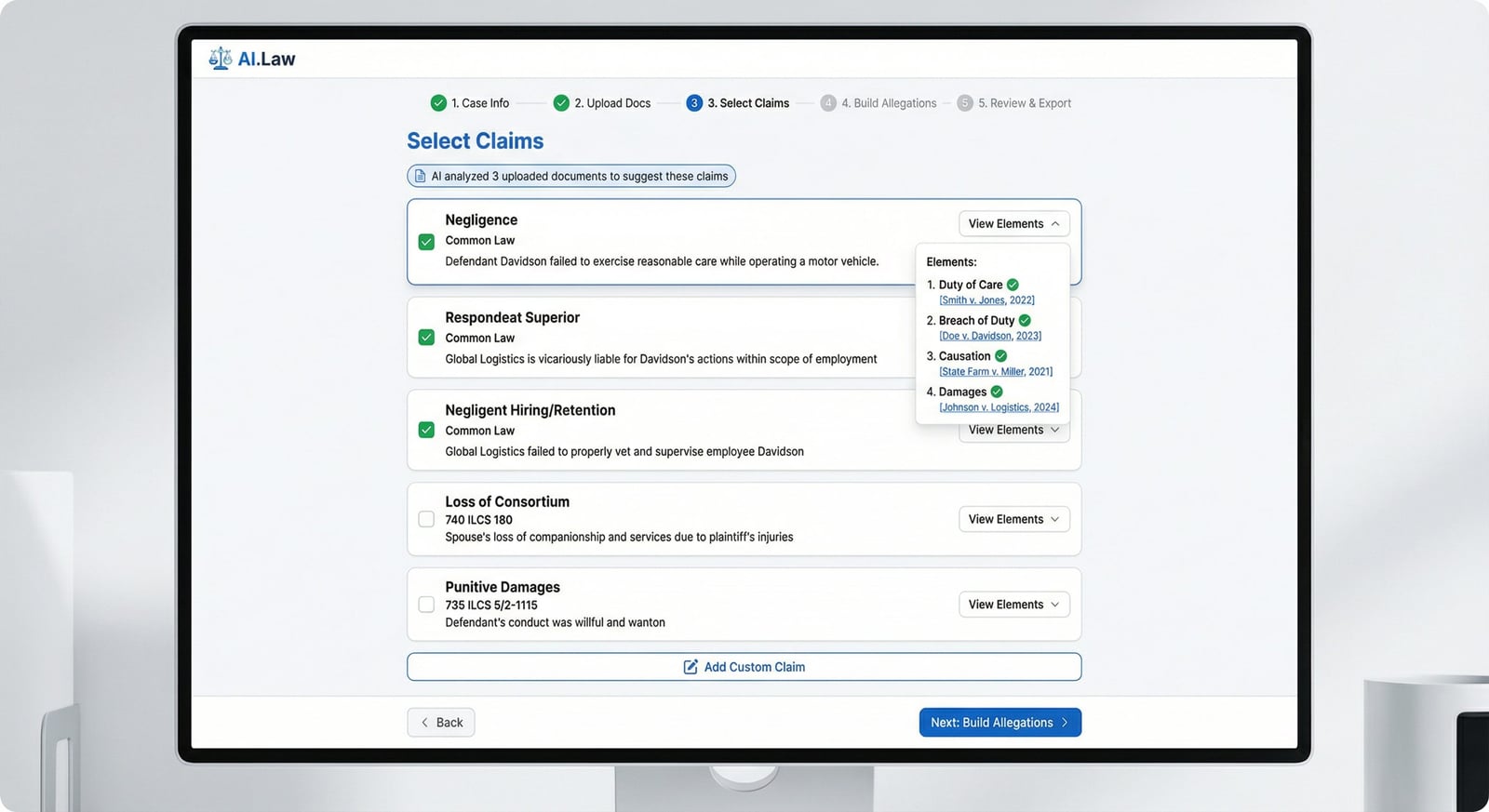
Real claims → real discovery
Matter context: Filed claims: negligent entrustment + respondeat superior · defendant corporate employer · client facts: driver on delivery route, prior speeding tickets in personnel file
AI.Law drafts: 25 interrogatories (subpart-compliant): hiring/training/supervision of driver, knowledge of prior incidents, cell-phone policy at time of crash · 30 targeted RFPs: personnel file, GPS logs, maintenance records · RFAs pinning date/time of impact.
Responses pull client-specific facts from intake and cite Rule 26(b)(1) proportionality on objections.
Federal & state discovery drafting FAQs
Are interrogatories subpart-compliant for jurisdictions with a 25-interrogatory limit?
Yes. AI.Law structures interrogatories with subpart counting in mind for jurisdictions that treat subparts separately, and drafts contention interrogatories appropriate to the discovery stage.
How are objections handled on discovery responses?
Objections cite specific grounds — privilege, work product, overbreadth, Rule 26(b)(1) proportionality — with a factual basis, followed by substantive answers incorporating your client's intake narrative where applicable.
Can AI.Law draft a motion to compel when responses are deficient?
The discovery deficiency tool identifies evasive answers; the motions tool drafts Rule 37 motions to compel with response-by-response analysis. Discovery drafting and motions share the same matter facts.
How attorneys use Discovery Drafting
Real scenarios from litigation practice — not hypotheticals.
Initial written discovery in an MVA case
You filed the complaint last week and need to serve initial written discovery within the timeframe set by the Rule 16 scheduling order. You need interrogatories that identify the defendant's insurance coverage, prior accidents, cell phone usage at the time of the collision, and any witnesses. You need requests for production targeting the police report, cell phone records, vehicle maintenance records, dash cam footage, and insurance policy declarations pages. And you need requests for admission to narrow the issues — the defendant was operating the vehicle, the collision occurred at the intersection of Main and Third, the defendant was insured by State Farm policy number XYZ. AI.Law drafts all three sets of discovery tailored to your specific claims and case facts — not generic templates that miss the issues unique to your case.
Targeted discovery based on a specific defense strategy
The defendant's answer asserts comparative negligence, claiming your client was speeding. You need discovery specifically targeted at testing that defense — interrogatories asking the factual basis for the speeding allegation, requests for production for any evidence supporting it (witness statements, expert reports, traffic camera footage, EDR data), and requests for admission that the defendant has no physical evidence of speeding. AI.Law analyzes the asserted defenses and drafts discovery designed to either eliminate the defense early or identify the evidence you need to rebut it at trial.
Propounding RFAs to narrow trial issues
Trial is four months away and you want to lock down the undisputed facts. You draft requests for admission covering liability (the defendant ran the red light), damages (the plaintiff incurred $47,832 in medical expenses), and authenticity (the medical records from Dr. Chen are authentic business records). AI.Law generates RFAs that are specific enough to be meaningful but drafted carefully to avoid the easy "denied" response — each request targets a single fact, uses language the defendant cannot reasonably dispute, and avoids compound or ambiguous phrasing that would give opposing counsel grounds to object.
Discovery in a complex commercial case
Your client's business was damaged by a supplier's breach of contract. The claims involve breach of express warranty, breach of implied warranty, negligent misrepresentation, and consequential damages including lost profits. Each claim requires different discovery — the warranty claims need the original contract, marketing materials, and pre-sale communications; the misrepresentation claim needs communications showing what representations were made and by whom; and the lost profits claim needs the plaintiff's financial records and the defendant's knowledge of the plaintiff's business purpose. AI.Law drafts discovery organized by claim, ensuring comprehensive coverage without the redundancy that comes from drafting each set independently.
More Detail
Case-specific interrogatories, RFPs, RFAs, and responses — not recycled templates
Every litigator has a discovery folder full of old requests they copy from case to case. The problem: those requests weren't written for this case, these claims, or these facts. AI.Law reads your uploaded case documents — the complaint, medical records, police reports, contracts — and generates discovery that targets the actual evidence you need. Responses incorporate your client's specific facts from AI-delivered intake, with objections citing the correct grounds: overbroad, unduly burdensome, proportionality under Rule 26(b)(1), attorney-client privilege, work product doctrine, or relevance.
- Interrogatories drafted from your actual claims — contention interrogatories, damage interrogatories, witness identification — with subpart compliance for jurisdictions with the 25-interrogatory limit
- RFPs that target documents actually relevant to your case theory — not generic categories that invite objections
- RFAs that pin down the facts opposing counsel cannot dispute, setting up summary judgment or narrowing trial issues
- Responses that go beyond boilerplate objections — each objection states specific grounds with factual basis, then provides a substantive answer incorporating your client's facts from intake
Faster
A 47-page set of discovery responses in 5 minutes — including objections
You know the math: 25 interrogatories with subparts, 30 RFPs, and a 30-day response window. When three sets of discovery arrive the same week, you're facing 90+ individual responses that each need specific objections and substantive answers woven with your client's facts. AI.Law processes all of it in minutes — objections with proper grounds, substantive responses with client-specific facts, and privilege logs where applicable.
- Full sets of interrogatory responses with specific objections and substantive answers — 5 minutes for 40+ pages
- RFP responses with document-by-document specificity instead of blanket objections that invite motions to compel
- AI pulls your client's specific facts from intake narratives and case documents into each substantive response
- Regenerate individual responses with different objection strategies without starting the entire set over
Easier
Select your matter and discovery type — AI does what your associate used to do
No more copying from the PI folder, the contract folder, or last month's case. Select the matter, pick interrogatories or RFPs or RFAs, and AI.Law generates requests tailored to the claims in your complaint or responses tailored to the opposing party's requests. Adjust specificity, add contention interrogatories, or narrow scope — then regenerate instantly.
- AI understands the difference between liability discovery, damages discovery, and third-party discovery
- Objections cite proper grounds — not just 'objection, overbroad' but specific proportionality and privilege bases
- Client facts from AI-delivered intake flow directly into substantive responses — no re-typing what the client already told you
- Export as Word document with your court's required formatting — numbered paragraphs, definitions section, instructions
More Money
Discovery goes from cost center to competitive advantage
Most firms treat discovery as a necessary evil — expensive to draft, tedious to respond to, and rarely billed at full value. AI.Law turns discovery into a strategic weapon. When drafting a set of targeted RFPs takes 5 minutes instead of 5 hours, you can afford to be aggressive. When responding with specific objections and client facts takes minutes, you never send the lazy blanket response that gets you sanctioned.
- Draft discovery aggressively on every case — not just the ones with enough budget for associate hours
- Deficiency letters generated automatically when opposing responses are evasive — with specific grounds for each deficiency
- Better discovery responses mean fewer motions to compel and fewer sanctions hearings
- More matters handled per attorney when the discovery bottleneck disappears
Stop copying discovery from old case files and hoping it fits
See what changes when AI handles the work instead.
| Area | The Old Way | With AI.Law |
|---|---|---|
| Drafting time | 3–5 hours per set of requests or responses | Complete draft in under 5 minutes — review, refine, and file |
| Tailoring | Copy from a prior case and manually adapt to new facts | Every request and response generated from your actual case documents, claims, and client facts |
| Objections | Boilerplate objections that invite motions to compel | Specific objections citing Rule 26(b)(1) proportionality, privilege, work product — with factual basis |
| Deficiency analysis | Read each response and note deficiencies by hand | AI identifies evasive responses and generates deficiency letters with specific grounds for each |
| Volume | Three sets of discovery arriving the same week = all-nighters | Handle any volume of discovery across all your cases — same day |
Discovery fits between your complaint and your deposition preparation
Written discovery doesn't exist in isolation — it's one step in a sequence. Before you draft discovery, the issue spotter has identified your claims and the action plan has mapped your discovery strategy. The complaint establishes the claims you're pursuing and the defenses you need to challenge. After you serve discovery and receive responses, the discovery deficiency tool identifies evasive answers and boilerplate objections. If the responses are inadequate, the motions tool drafts your motion to compel. And the documents produced in discovery flow into your document management system, where data extraction and medical analysis process them for the next phase — deposition preparation.
- Issue Spotter — Identify claims and defenses that drive your discovery strategy
- Action Plan — Map the discovery sequence, deadlines, and strategic priorities
- Discovery Drafting (this tool) — Draft interrogatories, RFPs, and RFAs tailored to your claims
- Discovery Deficiency — Analyze responses for evasion, boilerplate objections, and privilege log gaps
- Motions — Draft motions to compel when discovery responses are inadequate
- Deposition Analysis — Use produced documents to prepare deposition outlines and impeachment
Key discovery concepts every litigator should know
Understanding the legal framework behind the tool helps you get more from it.
Rule 26(b)(1) scope and proportionality
The 2015 amendments to Rule 26(b)(1) added proportionality as a limit on the scope of discovery. Parties may obtain discovery of "any nonprivileged matter that is relevant to any party's claim or defense and proportional to the needs of the case." Courts weigh the importance of the issues, the amount in controversy, the parties' access to the information, and the burden of production. Drafting discovery that is proportional — not just technically relevant — reduces the likelihood of successful objections and motions for protective orders.
Work product doctrine
The work product doctrine (codified in Rule 26(b)(3)) protects documents and tangible things prepared in anticipation of litigation from discovery. Fact work product (witness interview notes, document compilations) receives qualified protection — it can be discovered if the requesting party shows substantial need and inability to obtain the equivalent without undue hardship. Opinion work product (attorney mental impressions, conclusions, legal theories) receives near-absolute protection. Understanding the distinction helps you draft discovery requests that seek the facts, not the opposing counsel's analysis of the facts.
Requests for admission as trial efficiency tools
RFAs under Rule 36 are uniquely powerful because they are deemed admitted if not answered within 30 days, and admitted facts are conclusively established for purposes of the pending action. Strategic RFAs can eliminate the need to prove foundational facts at trial — the authenticity of documents, the accuracy of medical bills, the occurrence of undisputed events. Poorly drafted RFAs (compound, ambiguous, or argumentative) are easily denied or objected to. Well-drafted RFAs target single, specific facts that the opposing party cannot reasonably dispute.
ESI and e-discovery obligations
Electronically stored information (ESI) is discoverable under Rule 34, but the producing party may specify the form of production. A litigation hold must be issued when litigation is reasonably anticipated, and spoliation of ESI can result in adverse inference instructions or sanctions under Rule 37(e). When drafting discovery, specify the form of production you want (native format, searchable PDF, TIFF with load files) and include preservation language that puts the opposing party on notice of their obligations.
Contention interrogatories
Contention interrogatories ask a party to state the factual basis for a legal contention — for example, "State all facts supporting your allegation that the defendant was negligent." While technically permissible under Rule 33(a)(2), many courts defer them until after other discovery is complete. They are most effective late in the discovery period to pin down the opposing party's theory of the case before depositions and dispositive motions. Early in the case, they typically produce objections and evasive responses.
Three steps in one discovery lifecycle
- Step 1: Draft outgoing discovery — Interrogatories, RFPs, and RFAs tied to your claims.
- Step 2: Respond to incoming discovery — Objections and substantive answers from your file.
- Step 3: Flag deficient responses — Gap analysis and deficiency letters when answers fall short.
Related tools for Discovery Drafting
Same matter file, same uploads — keep working in this litigation workflow cluster.
- Draft responses with Rule 26(b)(1) objections and client facts — Discovery Responses
- Identify evasive answers and draft deficiency letters — Discovery Deficiency Letters
- Organize productions with Bates indexing after responses arrive — Discovery Compilation
- File Rule 37 motions to compel on deficient discovery — Motion Drafting
- Align discovery requests with claims in your complaint — Lawsuit Drafting
Browse all Discovery tools on the features hub, or see all features.
Free practice management. Pay only for AI you use.
Run your firm on Free Forever at $0 — CRM, calendar, billing, and document management for everyone. Add paid AI seats only for the people who need them, all on one plan for your firm: Core, Litigator, or Advanced.
- 11 tools free forever — no credit card required
- One plan for your firm — every paid seat on the same plan
- Cancel any paid seat anytime — no lock-in
- Annual billing: 12 months for the price of 11 on paid seats
- Free Forever practice management stays at $0
SOC 2 Type II Certified · Patented Technology · No AI Training on Your Data · You Own Your Data
Explore More
AI drafts objections and substantive answers to every discovery request — calibrated to the specific claims and defenses in your case
Upload the incoming discovery requests and AI.Law drafts complete responses: proper objections based on the specific requests and your jurisdiction’s rules, substantive answers informed by the case file, privilege assertions where applicable, and responses formatted for export. Not generic boilerplate — case-aware responses that understand what is at issue and what is responsive.
Get started with Discovery Drafting
Open a free practice management account, or build an AI plan when you’re ready.
No credit card required.
Need a firm or enterprise plan? Talk to our team