Negligence per se, respondeat superior, dram shop, punitive damages — every viable claim and enhancement identified from your case files
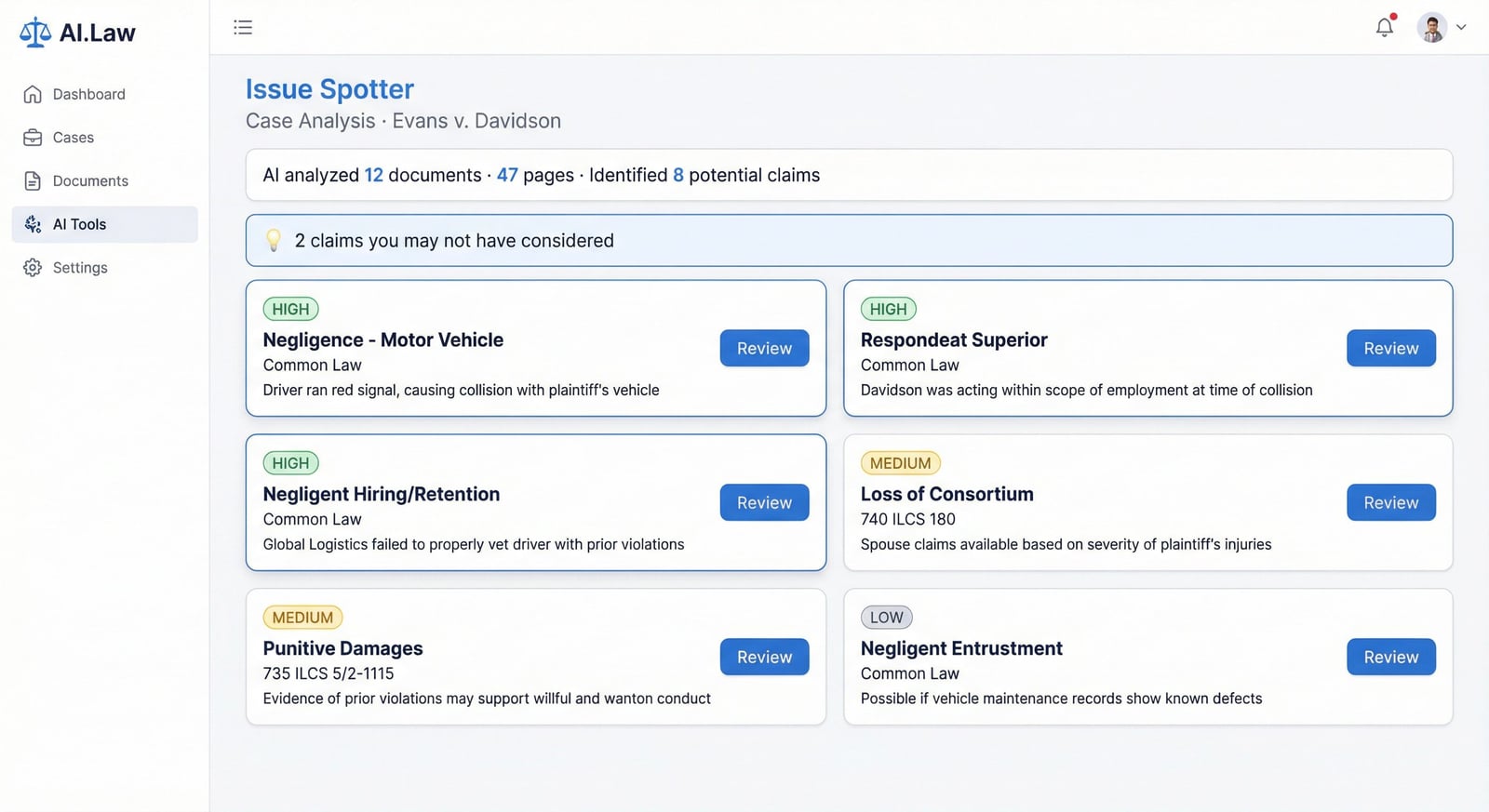
Upload the police crash report, medical records, and billing statements. AI.Law identifies every viable claim — negligence, negligence per se from a traffic code violation, respondeat superior against the employer, dram shop liability if alcohol was involved, loss of consortium, wrongful death — plus damage enhancements like punitive damages under your jurisdiction’s standard, per diem pain and suffering arguments, future medical costs from the surgical plan, and spoliation arguments if evidence was destroyed. Each finding includes confidence levels, cited case law, and clickable references to the source documents.
Open Your Free Plan · Book a Demo
How Issue Spotter works on a live matter
Issue Spotter is the AI.Law tool civil litigators use for document, research, and case-strategy work. An experienced attorney reviewing a new PI case reads the police crash report, reviews the medical records, checks the billing, and mentally inventories the claims. That takes 2–4 hours for a complex case with multiple defendants. AI.Law does this analysis in minutes — reading every page, cross-referencing the officer’s findings against the medical evidence, identifying the at-fault parties and their relationships, and mapping every viable claim to the facts in the record. By the time you finish reading the police report, the Issue Spotter has already completed the full assessment.
On a live matter it runs in 4 steps: (1) Upload case documents, (2) AI cross-references everything, (3) Review claims and enhancements, (4) Act on the analysis. Add police crash reports, medical records, billing statements, witness statements, employment records, toxicology reports — any documents relevant to the matter.
On a caseload of 80+ matters, even experienced litigators miss claims. The police report mentions the at-fault driver was on the clock — that’s respondeat superior against the employer and potentially the vehicle owner. The toxicology report shows a BAC of .14 — that’s a dram shop claim against the bar that over-served. The defendant’s dash cam footage was "lost" after litigation hold — that’s a spoliation argument. The traffic code section the officer cited in the crash report — that’s negligence per se. AI.Law reads every uploaded document, cross-references facts across sources, and surfaces every viable claim with the legal basis, confidence level, and cited case law for each. Negligence per se identified from traffic code violations cited in police reports, building code violations in premises cases, and regulatory violations in product liability — with the specific statute cited.
What Issue Spotter surfaces for the file
The output is designed to widen the lawyer's field of vision early, before key strategic decisions lock in the shape of the case.
- Potential claims and defenses tied to the actual facts in the matter record
- Confidence levels showing which theories appear strongest and which need more investigation
- Damage categories and enhancements that may be underdeveloped or overlooked
- Missing-evidence alerts that suggest follow-up discovery or preservation steps
- Supporting reasons tied to the documents, intake responses, and extracted data already in the file
- Potential employer, owner, or third-party liability theories beyond the immediately visible defendant
- Issue lists that help drive complaint drafting, discovery strategy, and early case valuation
How It Works
Get started in minutes. No training required.
1. Upload case documents
Add police crash reports, medical records, billing statements, witness statements, employment records, toxicology reports — any documents relevant to the matter.
2. AI cross-references everything
Issue Spotter reads every page, cross-references facts across documents — the traffic violation in the police report, the employer relationship in the incident details, the alcohol evidence in the toxicology — and maps every viable claim.
3. Review claims and enhancements
See every identified claim organized by confidence level with expandable elements, cited case law, and factual support. Damage categories itemized with specific dollar amounts and enhancement opportunities.
4. Act on the analysis
Add identified claims to your complaint, use damage totals and per diem calculations in settlement correspondence, follow recommended next steps for case development, and identify what additional evidence you need.
How attorneys use Issue Spotter
Real scenarios from litigation practice — not hypotheticals.
Finding claims the intake narrative did not spell out
A crash report and intake interview make the case look like a simple rear-end collision, but the truck driver was working for a regional carrier, the electronic logs suggest fatigue, and a maintenance invoice raises questions about brake condition. AI.Law's issue spotter does not stop at ordinary negligence. It flags respondeat superior, negligent entrustment, negligent maintenance, punitive-damages exposure if the conduct supports it, and possible spoliation issues if the carrier failed to preserve logs or inspection data. That broadens the case before the complaint is locked in.
Identifying damage theories beyond the obvious bills
The client has medical expenses and missed work, but the file also contains a treating physician recommendation for future surgery, a spouse statement about household limitations, and a vocational note about permanent restrictions. Issue Spotter pulls those threads together and surfaces future medicals, future wage loss, loss of consortium, and enhanced pain-and-suffering framing that might otherwise stay buried in the records. The lawyer still chooses what to pursue, but the tool reduces the risk that a meaningful damage category goes unrecognized.
Testing product and premises theories in a mixed-fault case
A client falls in a store vestibule during a rainstorm. At first pass, it looks like a routine premises claim. But the incident photos show a broken floor mat system, and the surveillance clip suggests the automatic door kept tracking water into the same area all day. Issue Spotter can flag premises liability, negligent maintenance, product-related theories involving the entry system, notice issues, and comparative-fault vulnerabilities - all from one pass through the matter documents. That helps you decide early whether the case should remain simple or needs broader investigation.
Turning raw facts into a litigation strategy conversation
Before the first strategy meeting, you want more than a chronology. You want a list of what the case could be about: strongest claims, weak points, likely defenses, missing evidence, and which facts matter most. Issue Spotter converts uploaded facts into that kind of strategic inventory. Instead of a vague discussion about whether the case "looks good," the team can talk concretely about notice, causation, agency, comparative fault, punitive exposure, missing witnesses, and document gaps.
More Detail
Claims a busy litigator might miss — respondeat superior, negligence per se, dram shop, spoliation — identified automatically
On a caseload of 80+ matters, even experienced litigators miss claims. The police report mentions the at-fault driver was on the clock — that’s respondeat superior against the employer and potentially the vehicle owner. The toxicology report shows a BAC of .14 — that’s a dram shop claim against the bar that over-served. The defendant’s dash cam footage was "lost" after litigation hold — that’s a spoliation argument. The traffic code section the officer cited in the crash report — that’s negligence per se. AI.Law reads every uploaded document, cross-references facts across sources, and surfaces every viable claim with the legal basis, confidence level, and cited case law for each.
- Negligence per se identified from traffic code violations cited in police reports, building code violations in premises cases, and regulatory violations in product liability — with the specific statute cited
- Respondeat superior and vicarious liability flagged when documents show the tortfeasor was acting within the scope of employment, with analysis of employer liability theories
- Dram shop and social host liability identified when medical records or police reports indicate alcohol involvement — with jurisdiction-specific elements and defenses noted
- Punitive damages analysis under your jurisdiction’s standard — actual malice, conscious disregard, or willful and wanton conduct — with factual support cited from the case documents
Faster
Upload the police report and medical records — get a complete case assessment with every claim identified in minutes
An experienced attorney reviewing a new PI case reads the police crash report, reviews the medical records, checks the billing, and mentally inventories the claims. That takes 2–4 hours for a complex case with multiple defendants. AI.Law does this analysis in minutes — reading every page, cross-referencing the officer’s findings against the medical evidence, identifying the at-fault parties and their relationships, and mapping every viable claim to the facts in the record. By the time you finish reading the police report, the Issue Spotter has already completed the full assessment.
- Analysis runs automatically as documents are uploaded — the Issue Spotter starts working the moment files hit the matter, no separate button to click
- Multi-defendant analysis: AI identifies not just the at-fault driver, but the employer, vehicle owner, property owner, dram shop, and any other potentially liable party from the facts in the documents
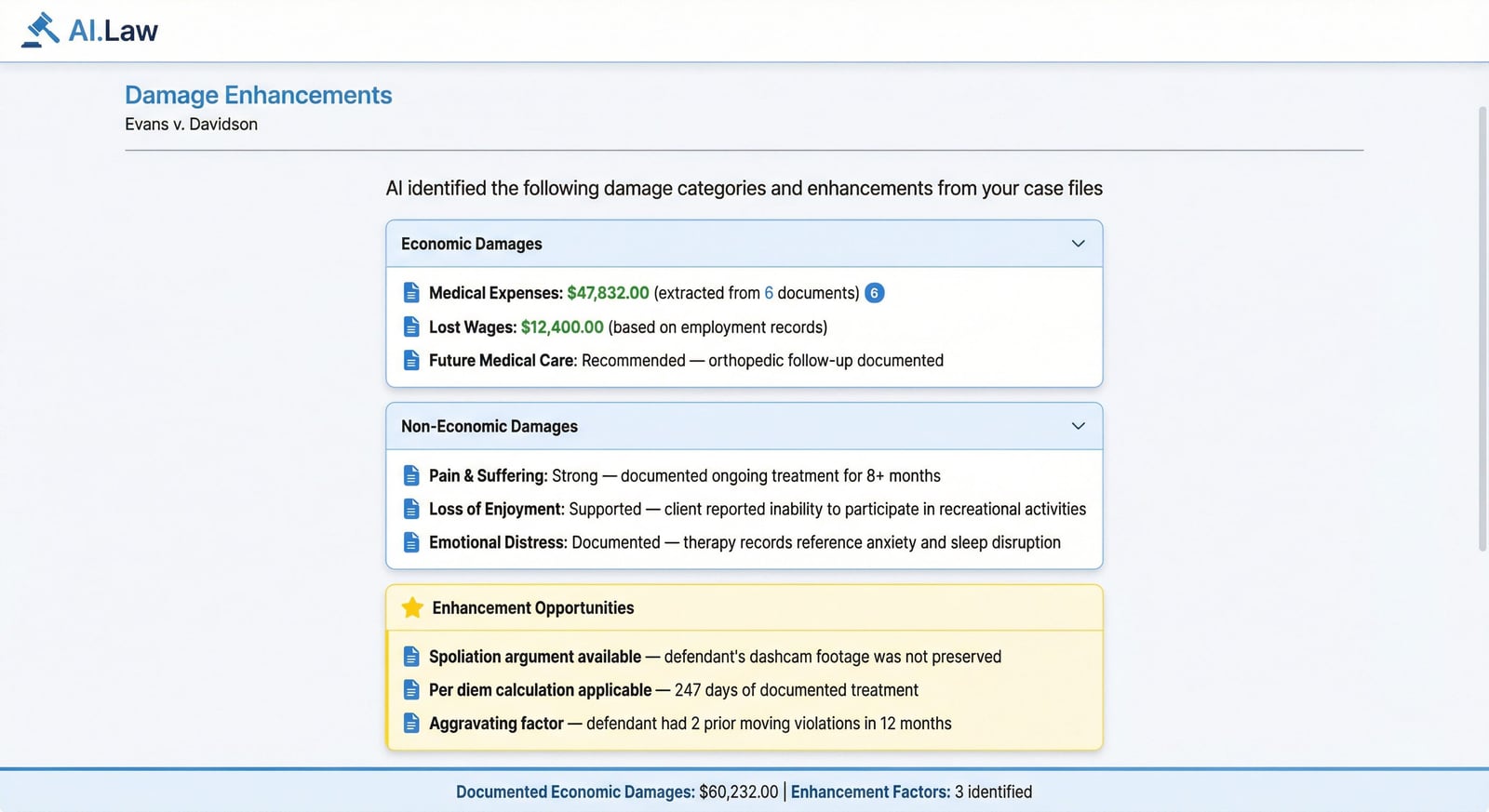
- Damage categories itemized with specific dollar amounts: past medical ($47,230), future medical (ACDF surgery estimate $89,000), lost wages ($12,400), loss of earning capacity, per diem pain and suffering, loss of consortium — each cited to source documents
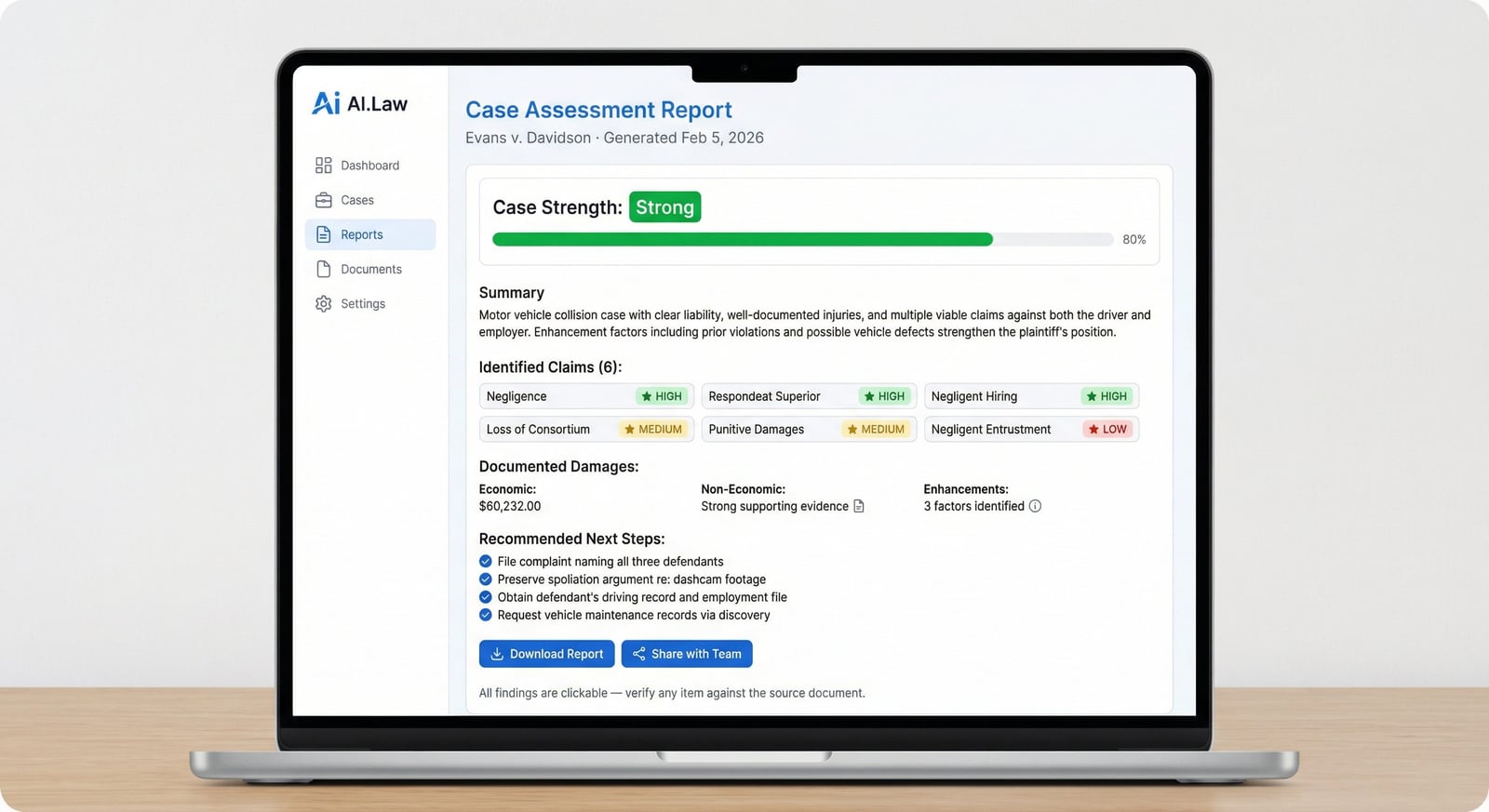
- Case strength rating with specific analysis of what makes the case strong, what weaknesses the defense will exploit, and what additional evidence you need to develop
Easier
Claims organized by confidence with expandable elements — click to see the evidence and add to your case
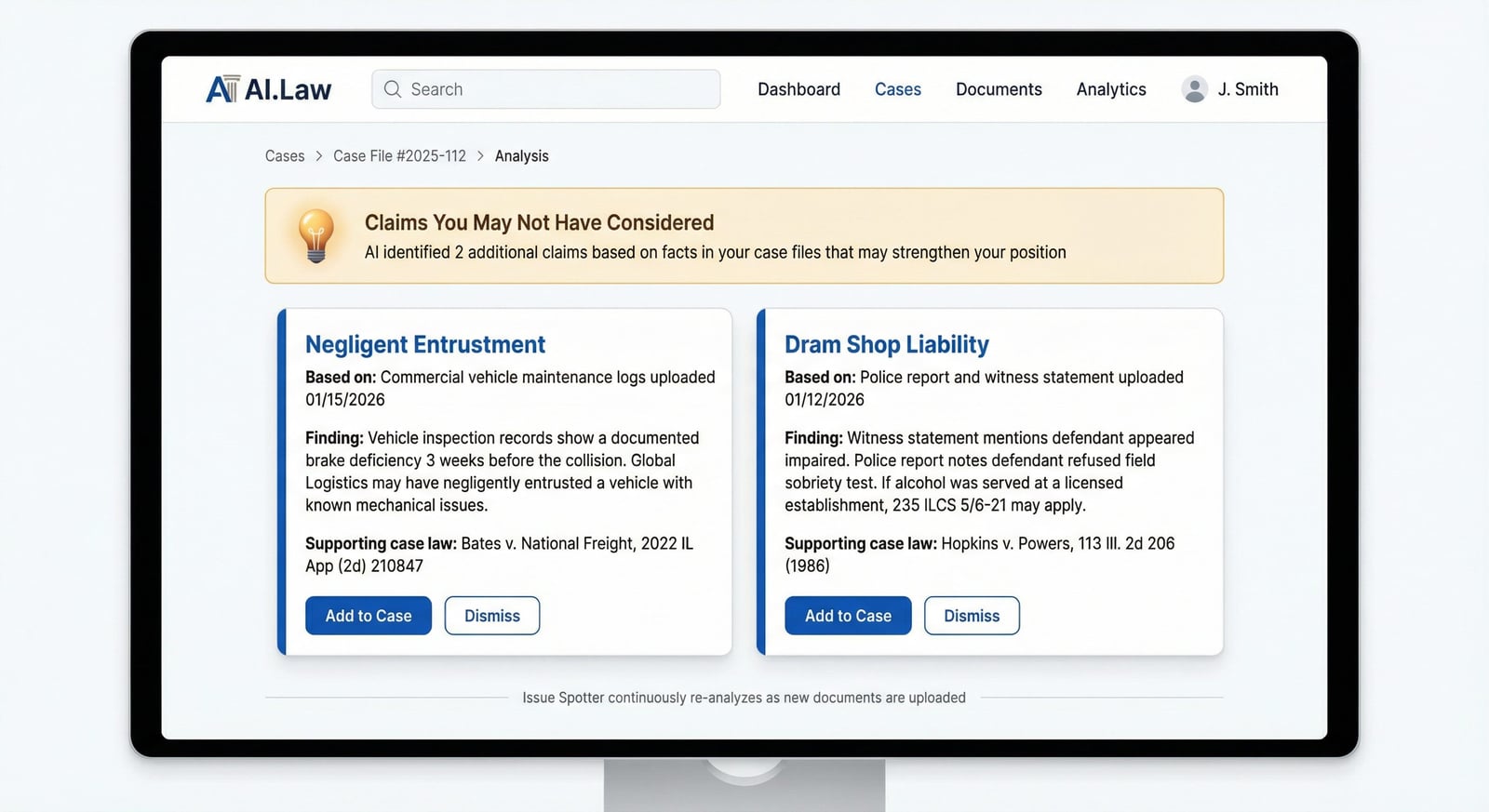
The Issue Spotter doesn’t just list claims — it shows you why each claim is viable. Expand any claim to see the specific legal elements, the factual support from your documents, the cited case law, and the confidence level. High-confidence claims have strong factual support across multiple documents. Medium-confidence claims have partial support but may need additional development. And the claims you didn’t consider — the respondeat superior, the dram shop, the spoliation argument — are flagged separately with a clear explanation of why the facts support them.
- Claims organized by confidence level (High, Medium, Low) with expandable element analysis — click to see what facts support each element and what’s missing
- Damage enhancements highlighted: per diem arguments for pain and suffering, future medical costs based on surgical recommendations in the records, hedonic damages in jurisdictions that allow them, punitive damages where conduct meets the threshold
- Every finding linked to the specific source document and page — click to jump directly to the police report page describing the traffic violation, or the medical record showing the surgical recommendation
- Continuously re-analyzes as new documents are uploaded — defense discovery responses, deposition transcripts, and expert reports all feed into updated claim analysis
More Money
The respondeat superior claim you didn’t catch is worth $200K in additional coverage — the Issue Spotter catches it every time
When the at-fault driver has minimum limits but was driving a company truck during working hours, the respondeat superior claim against the employer opens a commercial policy. That’s the difference between a $25K minimum-limits case and a $1M commercial policy case. When the police report shows the defendant left a bar 20 minutes before the crash and the BAC was .14, the dram shop claim opens the bar’s liquor liability policy. When the defense "lost" the surveillance footage, the spoliation instruction shifts the burden of proof. These are the claims that transform case values — and they’re exactly the ones that get missed on a busy Tuesday afternoon with three new cases on your desk.
- Respondeat superior and employer liability claims identified from employment indicators in documents — opening commercial policies that multiply available coverage
- Dram shop and social host claims flagged when alcohol involvement appears in police reports or medical records — opening separate liquor liability policies
- Punitive damages analysis identifies cases where the defendant’s conduct meets the jurisdiction-specific threshold — changing the entire settlement dynamic
- Per diem arguments, future medical estimates from surgical recommendations, and loss of earning capacity calculations give you comprehensive damage numbers from the first settlement package
Stop relying on memory and experience to catch every claim on a busy caseload
See what changes when AI handles the work instead.
| Area | The Old Way | With AI.Law |
|---|---|---|
| Claim identification | Attorney reads documents and lists claims from experience — misses less obvious theories under time pressure | AI identifies every viable claim including respondeat superior, negligence per se, dram shop, and spoliation — with elements and case law |
| Damage calculation | Paralegal manually totals bills — may miss future costs, per diem, and enhancement opportunities | Every damage category itemized with dollar amounts, future estimates, per diem calculations, and punitive damage analysis |
| Multi-defendant | Attorney may not identify all potentially liable parties from the facts | AI identifies every potentially liable party: driver, employer, vehicle owner, property owner, dram shop, government entity |
| Case assessment | Informal mental evaluation that depends on attorney bandwidth | Formal report with strength rating, claim analysis, damage totals, defense weaknesses, and recommended next steps |
| Ongoing analysis | Initial review rarely repeated as new documents arrive | Continuously re-analyzes with every new document upload — defense discovery, depositions, and expert reports update the assessment |
Issue spotting is where the rest of the matter strategy starts
A strong issue-spotting pass makes the downstream tools better because it changes what the lawyer chooses to investigate, plead, and prove. Once the documents are uploaded and extracted, Issue Spotter identifies what legal and factual threads appear worth pursuing. Legal research can then confirm the elements and standards for those theories. Lawsuit drafting can plead the right claims. Discovery can target the evidence needed to support or defeat them. Instead of each downstream tool starting from a blank slate, they start from a mapped field of plausible issues.
- Document Management — Collect the reports, records, emails, and exhibits that define the matter facts
- Data Extraction — Pull out the dates, parties, providers, costs, and structured details hidden in the documents
- Issue Spotter (this tool) — Surface the claims, defenses, damages, and vulnerabilities the team should evaluate first
- Legal Research — Confirm the governing elements, standards, and authority for the strongest issues
- Lawsuit Drafting — Convert the strongest supported issues into a complaint that matches the case theory
- Action Plan — Turn the spotted issues into an investigation, discovery, and motion strategy
Key concepts in claim and defense identification
Understanding the legal framework behind the tool helps you get more from it.
Negligence per se
Negligence per se uses the violation of a statute or safety regulation as the basis for establishing the duty-and-breach portion of negligence, assuming the statute was meant to protect the class of persons and type of harm at issue. Spotting a qualifying code or regulatory violation early can materially change the leverage and structure of the case.
Respondeat superior and direct employer negligence
Employer liability can arise in more than one way. Respondeat superior imposes vicarious liability for acts committed within the scope of employment, while negligent hiring, retention, supervision, or entrustment are direct theories against the employer itself. Issue spotting matters because a file may support one theory, the other, or both.
Spoliation and preservation duties
When a party knows litigation is likely, the duty to preserve relevant evidence can arise quickly. Destroyed surveillance video, overwritten logs, or missing internal communications can affect both proof and strategy. A good issue-spotting pass flags those risks while there is still time to send preservation demands or tailor discovery accordingly.
Comparative fault as a damages reducer
Even strong liability facts can be diluted if the plaintiff's conduct will be framed as a contributing cause of the harm. Comparative negligence, assumption of risk, mitigation issues, and seatbelt or treatment-gap arguments all change case value. Spotting those defenses early allows the lawyer to gather rebuttal evidence before the defense narrative hardens.
Related tools for Issue Spotter
Same matter file, same uploads — keep working in this litigation workflow cluster.
- Draft complaints for every claim the spotter finds — Lawsuit Drafting
- Turn identified issues into a litigation action plan — Action Plan
- Research elements for each spotted claim — Legal Research
Browse all Admin tools on the features hub, or see all features.
Free practice management. Pay only for AI you use.
Run your firm on Free Forever at $0 — CRM, calendar, billing, and document management for everyone. Add paid AI seats only for the people who need them, all on one plan for your firm: Core, Litigator, or Advanced.
- 11 tools free forever — no credit card required
- One plan for your firm — every paid seat on the same plan
- Cancel any paid seat anytime — no lock-in
- Annual billing: 12 months for the price of 11 on paid seats
- Free Forever practice management stays at $0
SOC 2 Type II Certified · Patented Technology · No AI Training on Your Data · You Own Your Data
Explore More
Early case assessment, discovery plan, deposition order, expert timeline — AI builds your litigation strategy from the case file
AI.Law reads every uploaded document and delivers a structured litigation strategy: early case assessment with case valuation, identified claims with element verification, recommended discovery plan (what to request in Rule 33/34/36 discovery, what to protect, timing relative to the scheduling order), deposition order strategy, expert retention timeline, anticipated Rule 12(b)(6) and Rule 56 defense motions with counter-arguments, and venue analysis — all with clickable citations to every referenced document.
Get started with Issue Spotter
Open a free practice management account, or build an AI plan when you’re ready.
No credit card required.
Need a firm or enterprise plan? Talk to our team