Identify evasive discovery responses — generate deficiency letters with grounds for compel
AI.Law reads opposing discovery responses, identifies every evasive, incomplete, or boilerplate answer, and generates a deficiency letter citing the specific inadequacy and legal grounds for a motion to compel under Rule 37. Response-by-response analysis. No deficiency missed.
How Discovery Deficiency Letters works on a live matter
Discovery Deficiency Letters is the AI.Law tool civil litigators use for written discovery. Reading through 30 interrogatory responses, identifying which are deficient, and drafting a letter that addresses each one individually takes an afternoon. AI.Law processes all responses simultaneously, identifies every deficiency, and generates a structured letter you can send within the hour.
On a live matter it runs in 4 steps: (1) Upload opposing responses, (2) AI identifies deficiencies, (3) Review the deficiency letter, (4) Send or convert to motion. Add the opposing discovery responses to your matter. AI.Law parses every answer, objection, and privilege assertion individually.
Opposing counsel responds to 25 interrogatories with 'Objection, overly broad and unduly burdensome' on every single one — then provides a two-sentence non-answer. Those responses are deficient, but writing a deficiency letter that addresses each one individually takes hours. AI.Law reads every response, identifies the specific deficiency in each answer — boilerplate objections without factual basis, incomplete responses, improper assertions of privilege without a privilege log — and generates a letter that puts opposing counsel on notice before you file the motion to compel. Each response analyzed individually — boilerplate objections, non-responsive answers, and improper privilege assertions identified with specific grounds.
All responses analyzed simultaneously — deficiencies identified in minutes, not hours. Upload opposing responses in any format — AI parses each answer and objection individually. Each output cites the source pages in your matter so you can verify it before you file.
What you get from Discovery Deficiency Letters
Every Discovery Deficiency Letters run is grounded in your uploaded matter — not a blank chat prompt. Here is what attorneys use on real cases:
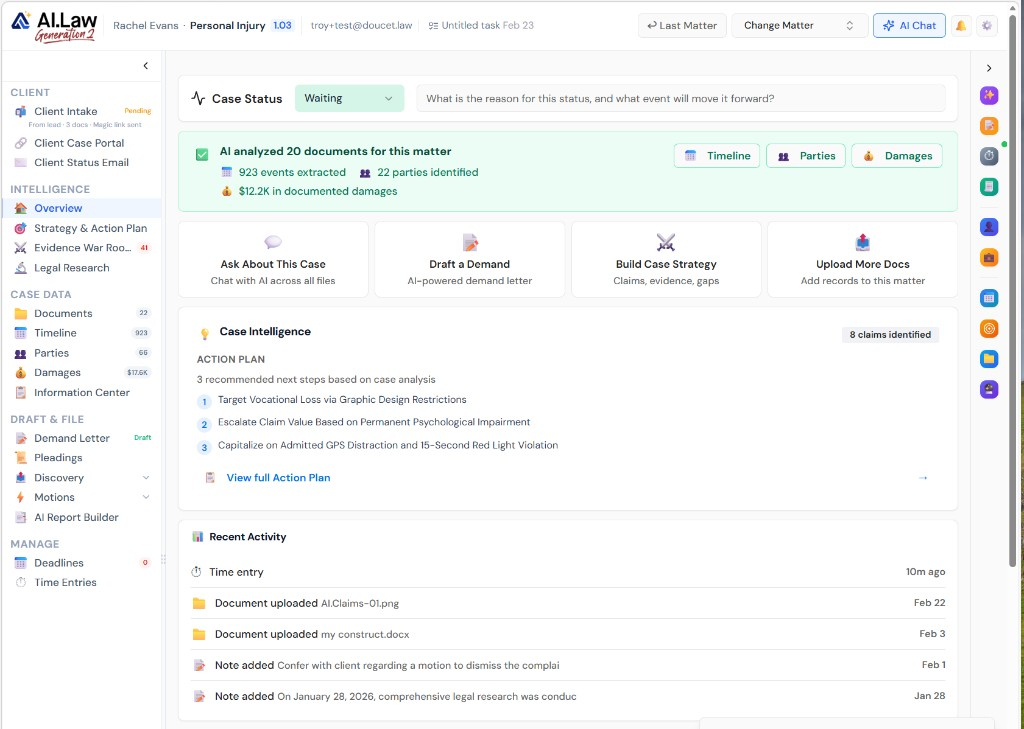
- Each response analyzed individually — boilerplate objections, non-responsive answers, and improper privilege assertions identified with specific grounds
- Deficiency letter drafted response-by-response with the legal basis for compulsion cited for each deficient answer
- Privilege log deficiencies flagged when opposing counsel asserts privilege without producing a log compliant with Rule 26(b)(5)
- The deficiency letter becomes the foundation for your motion to compel — demonstrating good-faith effort to resolve discovery disputes before filing under Rule 37
- All responses analyzed simultaneously — deficiencies identified in minutes, not hours
- Each deficient response cited with the specific inadequacy and the legal ground for compulsion
- Upload opposing responses in any format — AI parses each answer and objection individually
- AI distinguishes between legitimate objections with substantive answers and boilerplate objections with non-responsive answers
How It Works
Get started in minutes. No training required.
1. Upload opposing responses
Add the opposing discovery responses to your matter. AI.Law parses every answer, objection, and privilege assertion individually.
2. AI identifies deficiencies
Each response analyzed for adequacy — boilerplate objections, non-responsive answers, missing privilege logs, and incomplete supplementation flagged.
3. Review the deficiency letter
Get a structured letter addressing each deficient response with the specific inadequacy and legal ground for compulsion cited.
4. Send or convert to motion
Send the deficiency letter as a good-faith meet-and-confer. If not cured, the letter becomes the factual foundation for your Rule 37 motion to compel.
More Detail
Every boilerplate objection identified. Every incomplete answer flagged. Every ground for compel cited.
Opposing counsel responds to 25 interrogatories with 'Objection, overly broad and unduly burdensome' on every single one — then provides a two-sentence non-answer. Those responses are deficient, but writing a deficiency letter that addresses each one individually takes hours. AI.Law reads every response, identifies the specific deficiency in each answer — boilerplate objections without factual basis, incomplete responses, improper assertions of privilege without a privilege log — and generates a letter that puts opposing counsel on notice before you file the motion to compel.
- Each response analyzed individually — boilerplate objections, non-responsive answers, and improper privilege assertions identified with specific grounds
- Deficiency letter drafted response-by-response with the legal basis for compulsion cited for each deficient answer
- Privilege log deficiencies flagged when opposing counsel asserts privilege without producing a log compliant with Rule 26(b)(5)
- The deficiency letter becomes the foundation for your motion to compel — demonstrating good-faith effort to resolve discovery disputes before filing under Rule 37
Faster
Analyze 30 deficient discovery responses and draft the deficiency letter in minutes
Reading through 30 interrogatory responses, identifying which are deficient, and drafting a letter that addresses each one individually takes an afternoon. AI.Law processes all responses simultaneously, identifies every deficiency, and generates a structured letter you can send within the hour.
- All responses analyzed simultaneously — deficiencies identified in minutes, not hours
- Each deficient response cited with the specific inadequacy and the legal ground for compulsion
- Letter formatted as a good-faith meet-and-confer communication — satisfying the prerequisite for filing a motion to compel
- If they do not cure, the deficiency letter converts directly into the factual basis for your Rule 37 motion
Easier
Upload their responses — AI finds every deficiency you would have found (and some you might have missed)
Upload the opposing discovery responses to your matter. AI.Law reads every answer, every objection, and every privilege assertion — and flags the ones that are inadequate. You review the findings and send the letter. When the 30-day cure period expires without adequate supplementation, your motion to compel is already half-written.
- Upload opposing responses in any format — AI parses each answer and objection individually
- AI distinguishes between legitimate objections with substantive answers and boilerplate objections with non-responsive answers
- Deficiency analysis organized by severity — critical deficiencies that warrant immediate motion practice flagged separately
- Export as Word document formatted as a meet-and-confer letter ready to send to opposing counsel
More Money
Better discovery enforcement means better case outcomes — and it starts with the deficiency letter
Most discovery disputes are won or lost before the motion is filed. The deficiency letter establishes the record: you identified the deficiency, you communicated it in good faith, and opposing counsel failed to cure. When the motion to compel is filed, the judge sees a clear record of the deficiency and a reasonable request for supplementation that was ignored. AI.Law makes deficiency letters easy enough that you send them every time — not just when the deficiency is egregious.
- Send deficiency letters on every set of inadequate discovery — not just the ones bad enough to justify the drafting time
- Establish the record for motions to compel and fee-shifting under Rule 37
- Better discovery enforcement means more complete information for settlement correspondence, depositions, and trial
- Opposing counsel learns quickly that your discovery requests will be enforced — improving compliance on future requests
Stop letting evasive discovery responses slide because the deficiency letter takes too long
See what changes when AI handles the work instead.
| Area | The Old Way | With AI.Law |
|---|---|---|
| Analysis time | 2–4 hours to review responses and identify deficiencies | All responses analyzed and deficiencies identified in minutes |
| Specificity | Generic letter saying responses are inadequate | Response-by-response analysis with specific inadequacy and legal ground cited for each |
| Record building | Informal phone call that opposing counsel denies happened | Written deficiency letter establishing the good-faith meet-and-confer record for Rule 37 |
| Follow-through | Only pursue deficiency on the most egregious responses | Every deficient response identified and addressed — consistent enforcement |
| Motion prep | Start the motion to compel from scratch | Deficiency letter converts directly into the factual basis for the motion to compel |
Three steps in one discovery lifecycle
- Step 1: Draft outgoing discovery — Interrogatories, RFPs, and RFAs tied to your claims.
- Step 2: Respond to incoming discovery — Objections and substantive answers from your file.
- Step 3: Flag deficient responses — Gap analysis and deficiency letters when answers fall short.
Related tools for Discovery Deficiency Letters
Same matter file, same uploads — keep working in this litigation workflow cluster.
- Turn deficiencies into Rule 37 motions to compel — Motion Drafting
- Draft your own responses while tracking opposing gaps — Discovery Responses
- Draft targeted follow-up discovery on deficient topics — Discovery Drafting
- Use deposition testimony to prove discovery responses were false — Deposition Analysis
Browse all Discovery tools on the features hub, or see all features.
Free practice management. Pay only for AI you use.
Run your firm on Free Forever at $0 — CRM, calendar, billing, and document management for everyone. Add paid AI seats only for the people who need them, all on one plan for your firm: Core, Litigator, or Advanced.
- 11 tools free forever — no credit card required
- One plan for your firm — every paid seat on the same plan
- Cancel any paid seat anytime — no lock-in
- Annual billing: 12 months for the price of 11 on paid seats
- Free Forever practice management stays at $0
SOC 2 Type II Certified · Patented Technology · No AI Training on Your Data · You Own Your Data
Explore More
Motions to compel, dismiss, and for summary judgment — with full memoranda
AI.Law drafts complete motions with supporting memoranda of law, statement of facts, case citations, and jurisdiction-specific procedural compliance — from Rule 12(b)(6) dismissals to Rule 56 summary judgment to motions to compel under Rule 37. Full memoranda, not outlines.
Get started with Discovery Deficiency Letters
Open a free practice management account, or build an AI plan when you’re ready.
No credit card required.
Need a firm or enterprise plan? Talk to our team