Early case assessment, discovery plan, deposition order, expert timeline — AI builds your litigation strategy from the case file
AI.Law reads every uploaded document and delivers a structured litigation strategy: early case assessment with case valuation, identified claims with element verification, recommended discovery plan (what to request in Rule 33/34/36 discovery, what to protect, timing relative to the scheduling order), deposition order strategy, expert retention timeline, anticipated Rule 12(b)(6) and Rule 56 defense motions with counter-arguments, and venue analysis — all with clickable citations to every referenced document.
Open Your Free Plan · Book a Demo
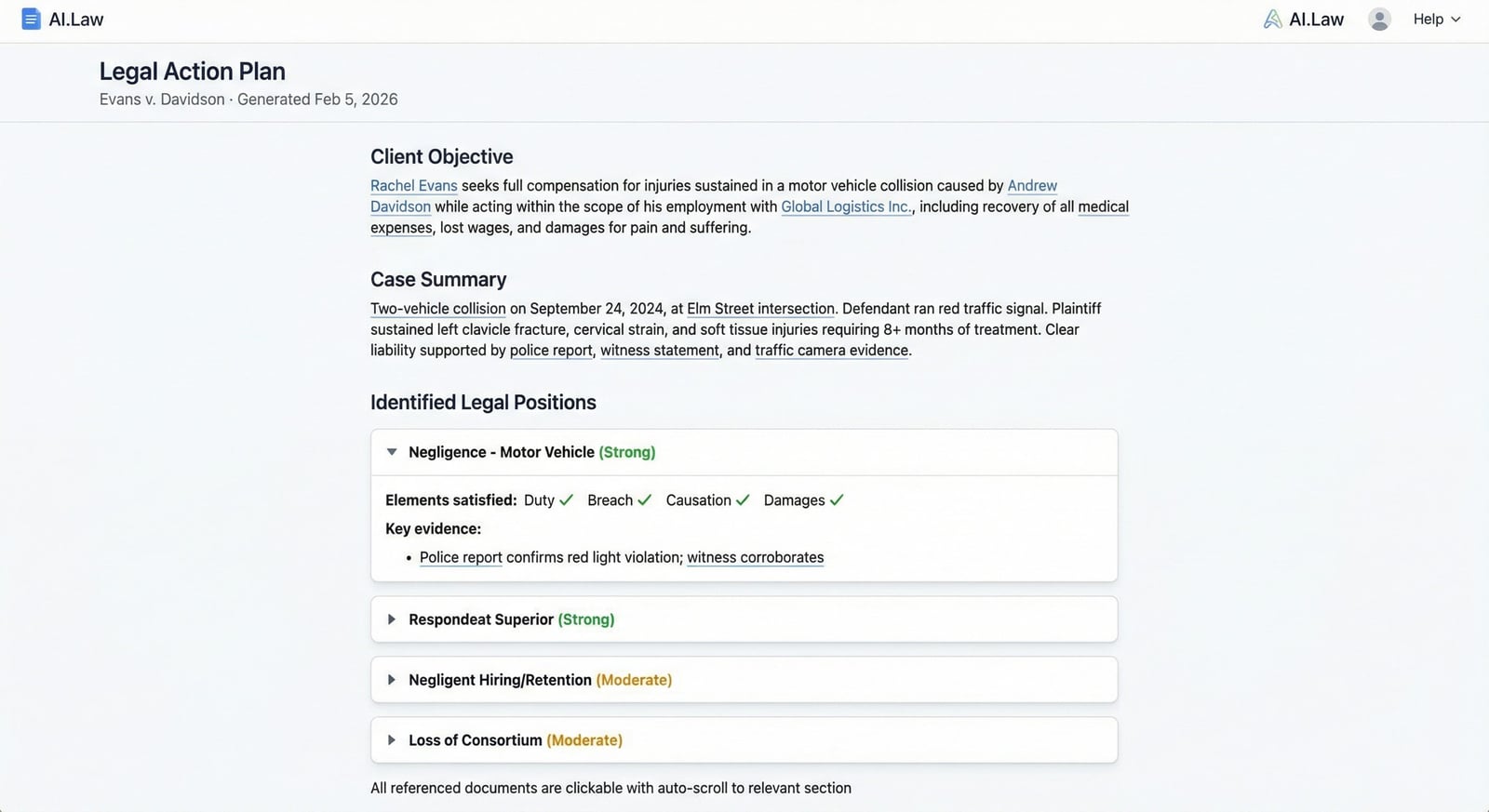
How Action Plan works on a live matter
Action Plan is the AI.Law tool civil litigators use for document, research, and case-strategy work. Every litigator has sat in an initial case review meeting, discussed the case for an hour, and walked out with a vague sense of the claims and a mental note to "think about discovery." AI.Law produces a structured, cite-checked litigation strategy in 10 minutes that would take that same attorney 4–6 hours to develop from scratch — reading every document, researching claim elements, thinking through the defense’s likely motions, and mapping out the discovery sequence. The Action Plan doesn’t replace your strategic judgment. It gives you a comprehensive starting point so your judgment can focus on refinement, not assembly.
On a live matter it runs in 4 steps: (1) Upload case documents, (2) Select your analysis topics, (3) AI generates the Action Plan, (4) Review, refine, and execute. Add police reports, medical records, witness statements, employment records, contracts, correspondence — any documents relevant to the matter.
A litigation strategy isn’t just a list of claims. It’s a sequenced plan: which claims to plead, what discovery to propound first, which witnesses to depose and in what order, when to retain experts, what Rule 12(b)(6) or Rule 56 challenges the defense will likely bring, and how to counter them. AI.Law’s Action Plan reads every uploaded document and builds this entire strategic framework — not a case summary, but a litigation roadmap with specific recommendations at each phase. The discovery plan identifies what to request in initial Rule 33/34/36 discovery and what to protect. The deposition order recommends which fact witnesses to take first and why. The expert timeline maps retention deadlines against your scheduling order.
What you get from Action Plan
Every Action Plan run is grounded in your uploaded matter — not a blank chat prompt. Here is what attorneys use on real cases:
- Early case assessment with case valuation range based on comparable outcomes, injury severity, liability strength, and venue characteristics — a real ECA, not a gut estimate
- Discovery plan: specific recommendations for initial interrogatories, RFPs, and RFAs based on your claims, what documents to request first, and what privilege and work product protections to assert
- Deposition order strategy: which fact witnesses to take first (and why the corporate representative before the individual defendant matters), and suggested areas of examination for each
- Anticipated defense motions with counter-arguments: the Rule 12(b)(6) motion they’ll file on your weakest claim, the summary judgment arguments on causation, the Daubert challenge to your expert — with prepared responses
- Complete case analysis generated automatically from every uploaded document — claims, damages, liability analysis, venue considerations, and case valuation
- Discovery and deposition planning mapped against your scheduling order deadlines — what to request first, who to depose first, and when experts need to be disclosed
- Toggle analysis sections on or off: liability analysis, damages, discovery plan, deposition order, expert timeline, anticipated motions, venue analysis, settlement posture — focus on what matters for this specific case
- Add custom analysis topics for unique case requirements: ERISA preemption analysis, government immunity evaluation, class certification factors, administrative exhaustion, certificate of merit requirements
How It Works
Get started in minutes. No training required.
1. Upload case documents
Add police reports, medical records, witness statements, employment records, contracts, correspondence — any documents relevant to the matter.
2. Select your analysis topics
Choose which sections AI should analyze — liability, damages, discovery plan, deposition order, expert timeline, anticipated motions, venue — or add custom topics for unique case requirements.
3. AI generates the Action Plan
AI reads every document and builds a comprehensive litigation strategy: claims with verified elements, discovery sequence recommendations, deposition order, expert retention timeline, and anticipated defense motions with counter-arguments.
4. Review, refine, and execute
Review each section with clickable citations to source documents. Refine the strategy based on your judgment. Share with your team. Execute the plan systematically with deadlines tracked through AI.Law’s calendar.
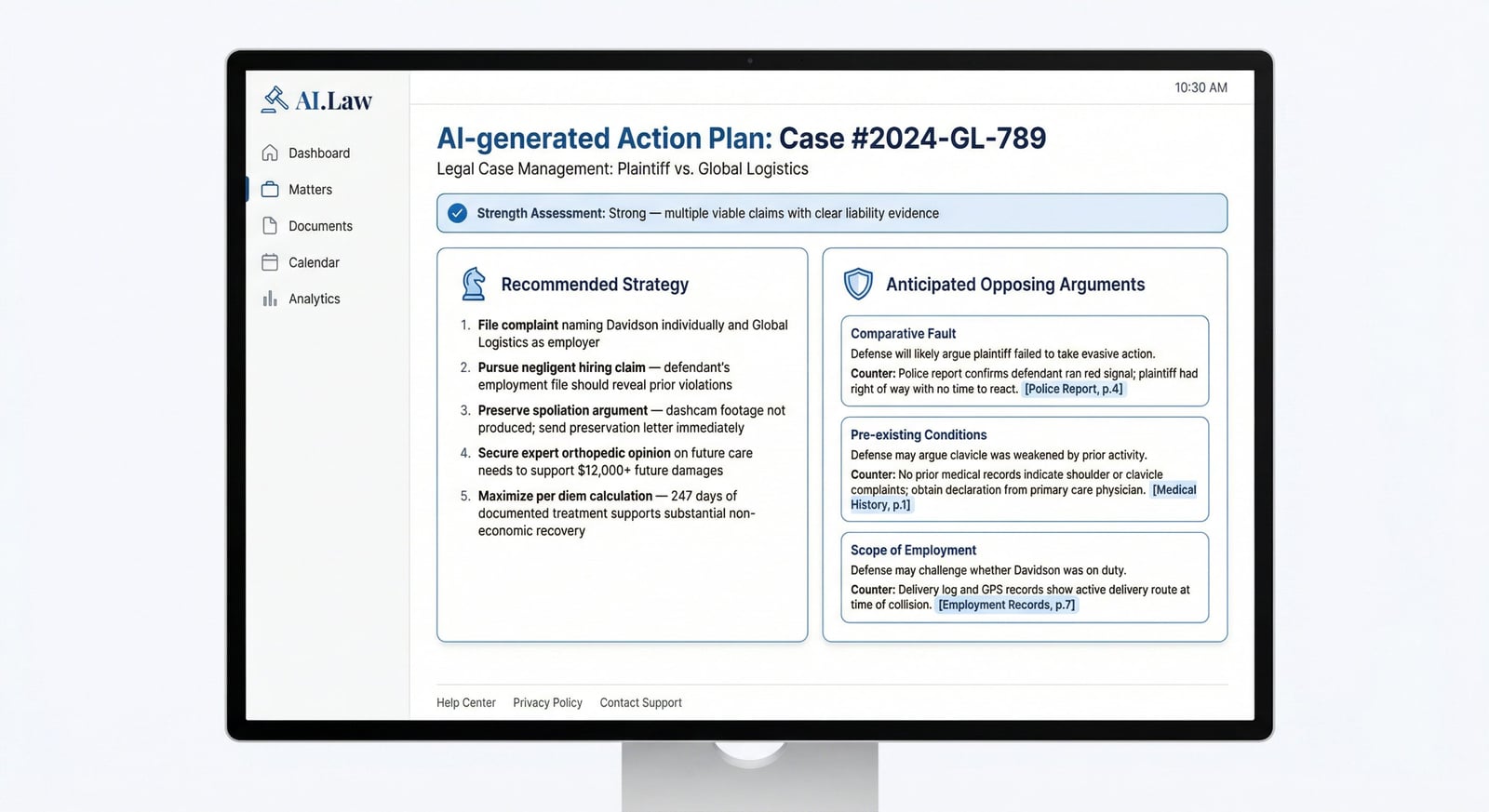
More Detail
Early case assessment, discovery plan, deposition strategy, expert timeline, and anticipated defense motions — from your actual case file
A litigation strategy isn’t just a list of claims. It’s a sequenced plan: which claims to plead, what discovery to propound first, which witnesses to depose and in what order, when to retain experts, what Rule 12(b)(6) or Rule 56 challenges the defense will likely bring, and how to counter them. AI.Law’s Action Plan reads every uploaded document and builds this entire strategic framework — not a case summary, but a litigation roadmap with specific recommendations at each phase. The discovery plan identifies what to request in initial Rule 33/34/36 discovery and what to protect. The deposition order recommends which fact witnesses to take first and why. The expert timeline maps retention deadlines against your scheduling order.
- Early case assessment with case valuation range based on comparable outcomes, injury severity, liability strength, and venue characteristics — a real ECA, not a gut estimate
- Discovery plan: specific recommendations for initial interrogatories, RFPs, and RFAs based on your claims, what documents to request first, and what privilege and work product protections to assert
- Deposition order strategy: which fact witnesses to take first (and why the corporate representative before the individual defendant matters), and suggested areas of examination for each
- Anticipated defense motions with counter-arguments: the Rule 12(b)(6) motion they’ll file on your weakest claim, the summary judgment arguments on causation, the Daubert challenge to your expert — with prepared responses
Faster
A complete litigation strategy in 10 minutes — not a two-hour attorney conference that produces three bullet points on a legal pad
Every litigator has sat in an initial case review meeting, discussed the case for an hour, and walked out with a vague sense of the claims and a mental note to "think about discovery." AI.Law produces a structured, cite-checked litigation strategy in 10 minutes that would take that same attorney 4–6 hours to develop from scratch — reading every document, researching claim elements, thinking through the defense’s likely motions, and mapping out the discovery sequence. The Action Plan doesn’t replace your strategic judgment. It gives you a comprehensive starting point so your judgment can focus on refinement, not assembly.
- Complete case analysis generated automatically from every uploaded document — claims, damages, liability analysis, venue considerations, and case valuation
- Discovery and deposition planning mapped against your scheduling order deadlines — what to request first, who to depose first, and when experts need to be disclosed
- Defense motions anticipated with specific counter-arguments and supporting case law — know what’s coming before it arrives so you’re never writing opposition briefs from a cold start
- Attorney time shifts from building the strategic framework to refining it — the creative, judgment-intensive work that actually differentiates a strong litigator from a mediocre one
Easier
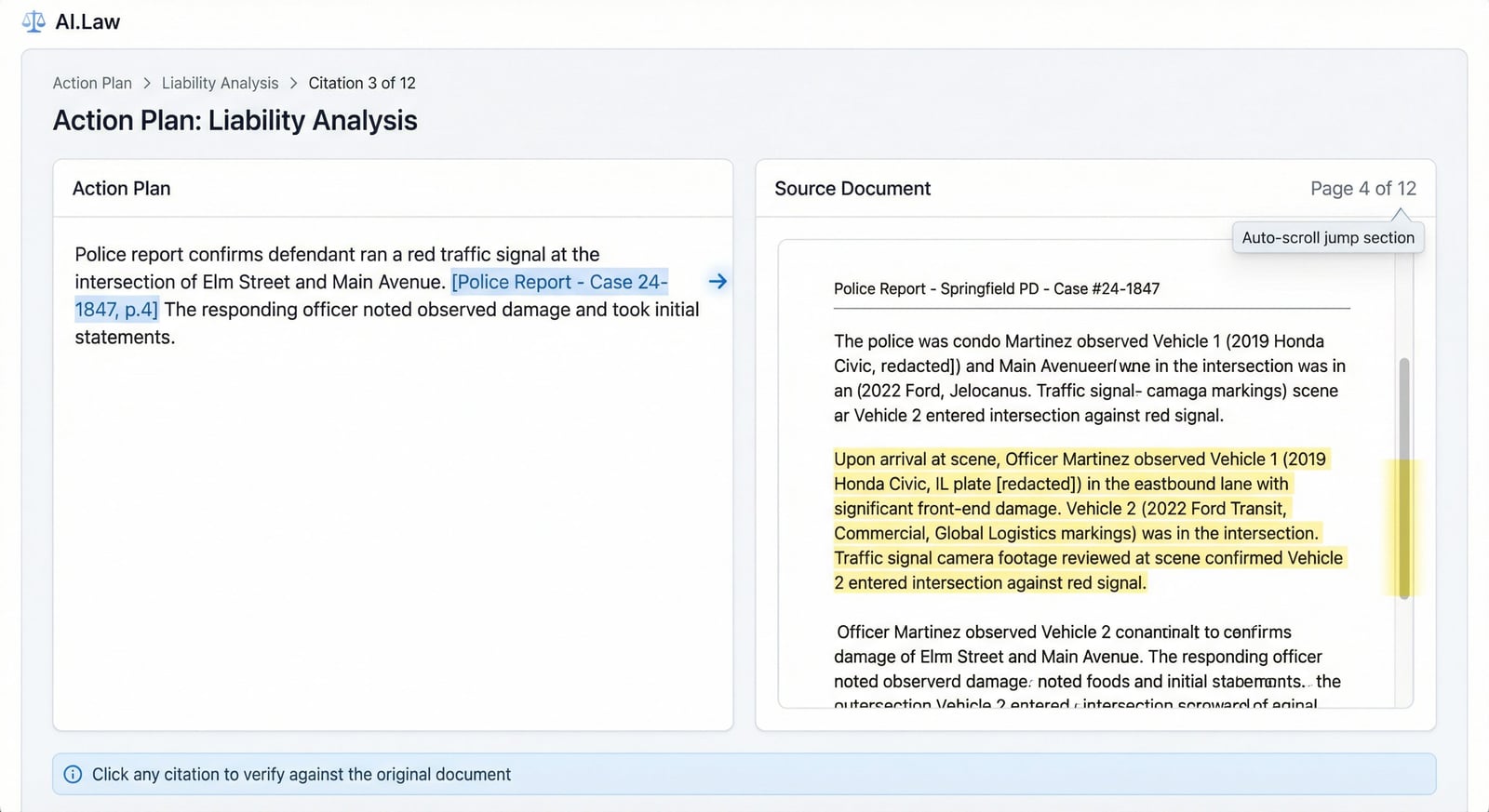
Customizable analysis sections — toggle what you need, add custom topics, get exactly the plan this case requires
A straightforward rear-end MVA needs a different action plan than a multi-defendant products liability case. AI.Law lets you toggle analysis sections on or off — client objective, case background, liability analysis, damages assessment, discovery plan, deposition order, expert retention, anticipated motions, venue analysis — and add your own custom topics. Handling an employment discrimination case? Add a section for administrative exhaustion requirements. Working a medical malpractice case? Add a section for certificate of merit and expert affidavit deadlines. The Action Plan adapts to the case, not the other way around.
- Toggle analysis sections on or off: liability analysis, damages, discovery plan, deposition order, expert timeline, anticipated motions, venue analysis, settlement posture — focus on what matters for this specific case
- Add custom analysis topics for unique case requirements: ERISA preemption analysis, government immunity evaluation, class certification factors, administrative exhaustion, certificate of merit requirements
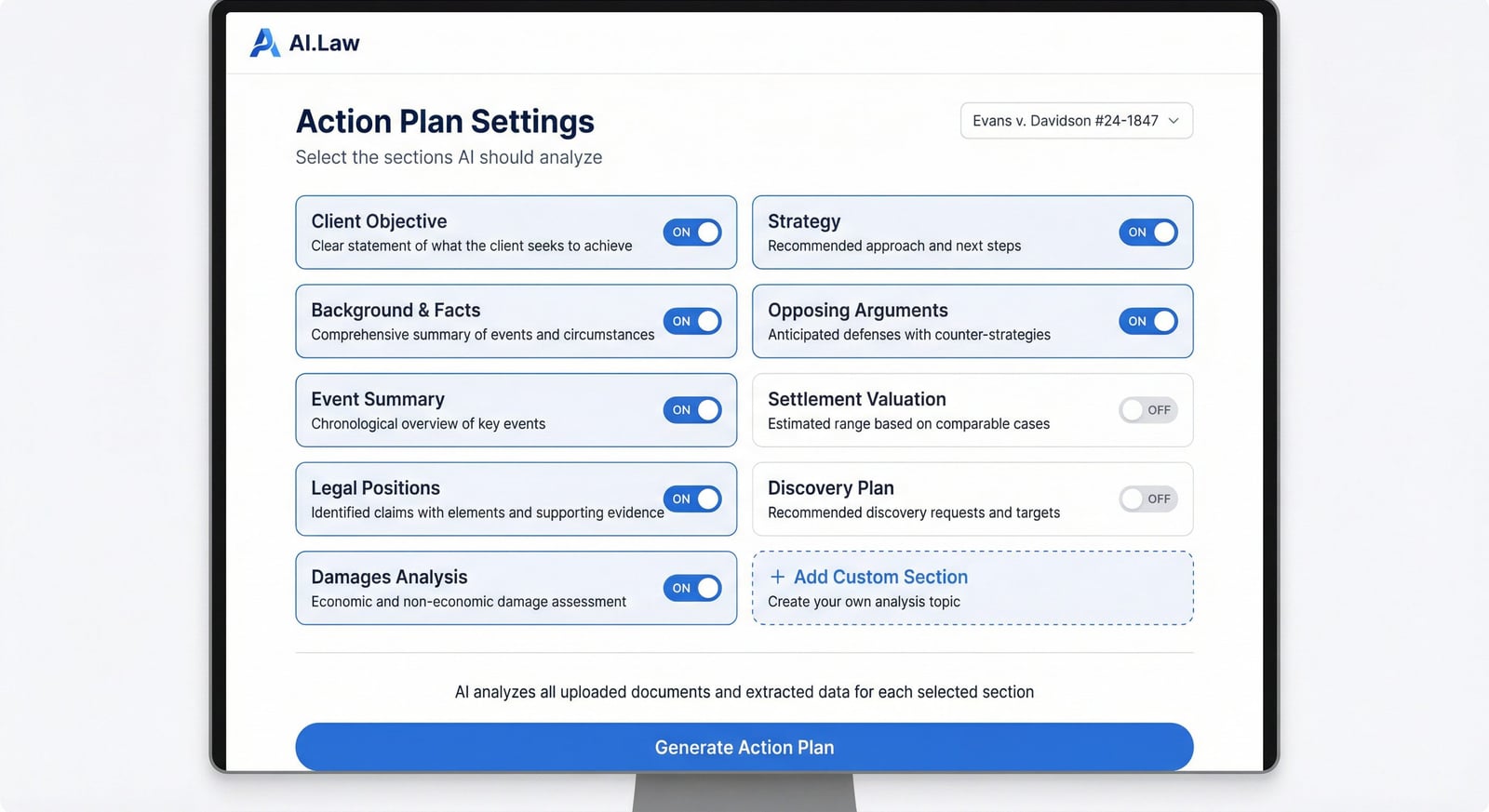
- Every finding includes clickable citations — click to jump to the highlighted passage in the source document for instant verification of the factual basis for each strategic recommendation
- Share the Action Plan with co-counsel, associates, and paralegals — a documented strategy that keeps the entire team aligned on objectives, priorities, and next steps
More Money
Cases with documented strategy from day one resolve faster, settle higher, and survive defense motions
The firm that files a complaint on Monday, sends targeted discovery on Wednesday, and schedules the corporate deposition before the fact witness changes the dynamic of the litigation. The defense knows they’re dealing with someone who has a plan. That changes settlement posture. It changes how the insurance company evaluates the claim. And it changes how the judge views your case when you walk into the first status conference with a proposed scheduling order that shows you’ve already mapped out the entire litigation. AI.Law gives every case in your practice that strategic advantage — not just the ones where you had time for a proper case review.
- Sequenced litigation plans that move cases forward systematically — each action building on the last — produce faster resolutions and earlier settlement pressure
- Anticipated defense motions with prepared counter-arguments mean you’re never scrambling to write a response brief from scratch
- Documented case strategy with cited evidence supports fee petitions, case evaluations at mediation, and settlement authority discussions with clients
- Cases with strategy from day one generate revenue faster — matters that sit idle waiting for someone to figure out the next step are matters that aren’t earning
Stop building litigation strategy from memory and sticky notes
See what changes when AI handles the work instead.
| Area | The Old Way | With AI.Law |
|---|---|---|
| Case analysis | Attorney reads documents and forms a mental picture over several days | Structured analysis of every uploaded document — claims, damages, liability, venue — in 10 minutes |
| Discovery planning | Attorney mentally notes what discovery to send — eventually | Specific discovery plan: what Rule 33/34/36 discovery to propound, what to protect, and timing against the scheduling order |
| Defense anticipation | React to defense motions as they arrive | Anticipated motions with prepared counter-arguments — Rule 12(b)(6), Rule 56, Daubert — before they’re filed |
| Documentation | Strategy lives in the attorney’s head or three bullet points on a legal pad | Complete written plan with citations — shareable, auditable, and executable |
| Expert timeline | Retained too late because no one tracked the disclosure deadline | Expert retention timeline mapped against scheduling order deadlines with calendar integration |
Related tools for Action Plan
Same matter file, same uploads — keep working in this litigation workflow cluster.
- Identify claims and defenses to feed the action plan — Issue Spotter
- Draft discovery aligned with the plan's sequence — Discovery Drafting
- Track evidence gaps the plan identifies — Evidence War Room
Browse all Admin tools on the features hub, or see all features.
Free practice management. Pay only for AI you use.
Run your firm on Free Forever at $0 — CRM, calendar, billing, and document management for everyone. Add paid AI seats only for the people who need them, all on one plan for your firm: Core, Litigator, or Advanced.
- 11 tools free forever — no credit card required
- One plan for your firm — every paid seat on the same plan
- Cancel any paid seat anytime — no lock-in
- Annual billing: 12 months for the price of 11 on paid seats
- Free Forever practice management stays at $0
SOC 2 Type II Certified · Patented Technology · No AI Training on Your Data · You Own Your Data
Explore More
Cross-reference depositions against discovery — find every impeachment opportunity
AI.Law reads every page of every transcript, compares testimony against interrogatory answers and RFP responses, cross-references multiple witnesses' statements, and generates impeachment charts with exact page-and-line citations. Prior inconsistent statements under Rule 613 — surfaced in minutes, not days.
Get started with Action Plan
Open a free practice management account, or build an AI plan when you’re ready.
No credit card required.
Need a firm or enterprise plan? Talk to our team