10 AI models embedded in every matter — ask anything about your case and get cited answers in seconds
Ask "What did the defendant say about the traffic signal in his deposition, and does it contradict the police report?" or "Total all medical bills after March 2024 when the defense claims treatment was no longer related." AI.Law’s built-in AI Associate reads across every uploaded document — medical records, deposition transcripts, discovery responses, police reports, correspondence — and returns detailed answers with clickable citations to the exact source. 10 AI models. Every document in the matter. No extra upload. No copy-paste.
Open Your Free Plan · Book a Demo
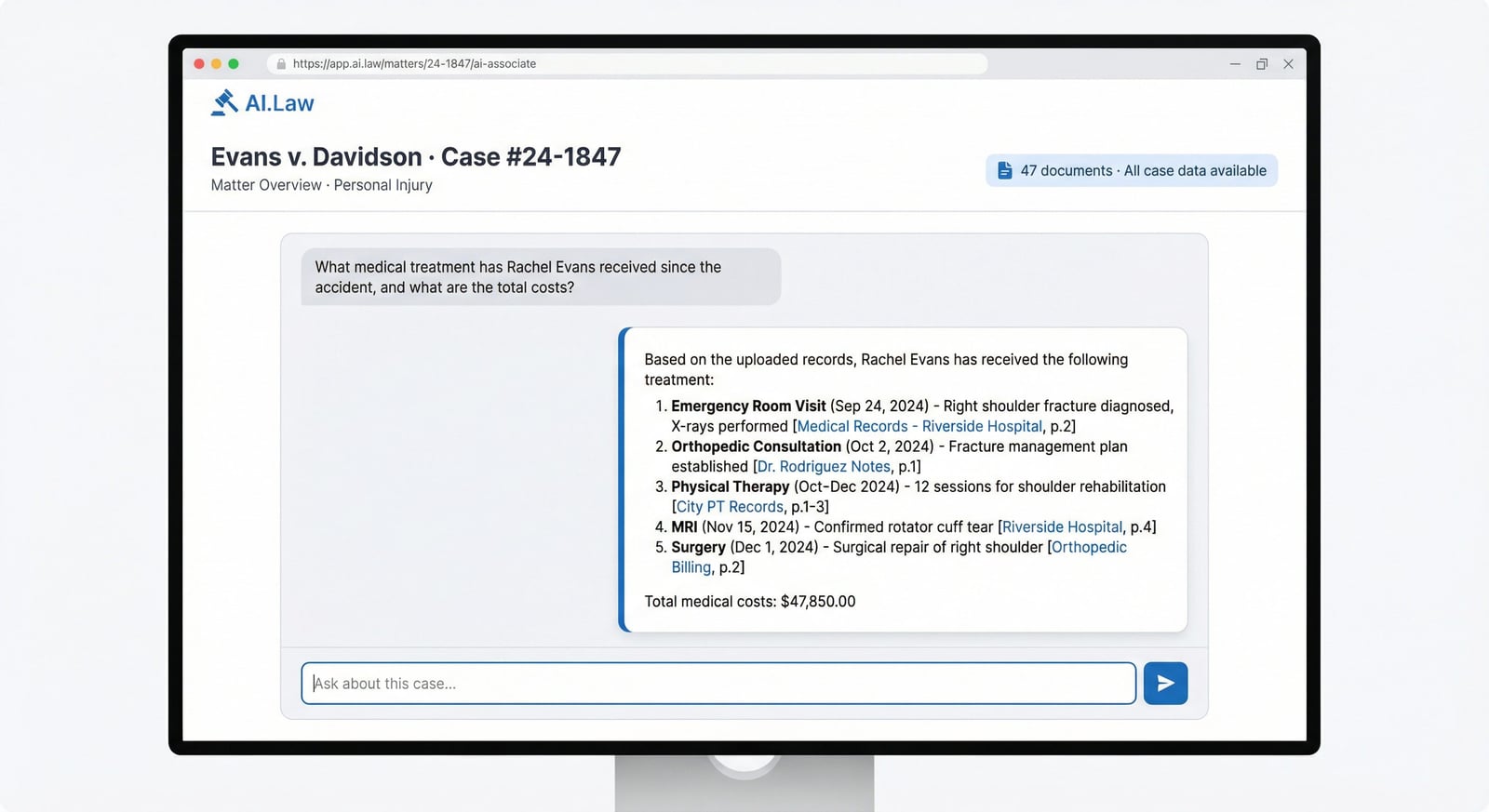
How AI Associate works on a live matter
AI Associate is the AI.Law tool civil litigators use for document, research, and case-strategy work. You’re deposing the corporate representative tomorrow. You need to know: what did the company produce in discovery about their inspection protocols, what did their fact witness say about maintenance schedules in his deposition, and does the incident report contradict the interrogatory answers about prior complaints? Without the AI Associate, that’s 3 hours of reading transcripts and cross-referencing documents. With the AI Associate, ask each question, get cited answers, and build your deposition outline in the time it takes to drink a cup of coffee.
On a live matter it runs in 4 steps: (1) Open any matter, (2) Ask your question, (3) Get cited answers, (4) Follow up and go deeper. The AI Associate is ready on every matter’s landing page. Every uploaded document, extracted data point, and timeline event is automatically available. No setup, no file selection.
The AI Associate isn’t a generic chatbot with your files attached. It reads and cross-references every document in the matter — deposition transcripts, interrogatory answers, medical records, police reports, correspondence, billing statements, intake narratives — and answers questions that require synthesis across multiple sources. Ask "Does the plaintiff’s description of the accident at intake match the police report?" and get a side-by-side analysis with citations to both documents. Ask "What is the total of all physical therapy charges billed after the IME report date?" and get an itemized answer with provider names, dates, and amounts cited to the billing records. Cross-document analysis: compare deposition testimony against interrogatory answers, medical records against intake narratives, police reports against witness statements — contradictions surfaced with citations to both sources.
Ask "What did each witness say about the condition of the stairway?"
What AI Associate gives you back
AI Associate answers are not generic chatbot replies. They are case-specific analyses grounded in the documents already inside the matter.
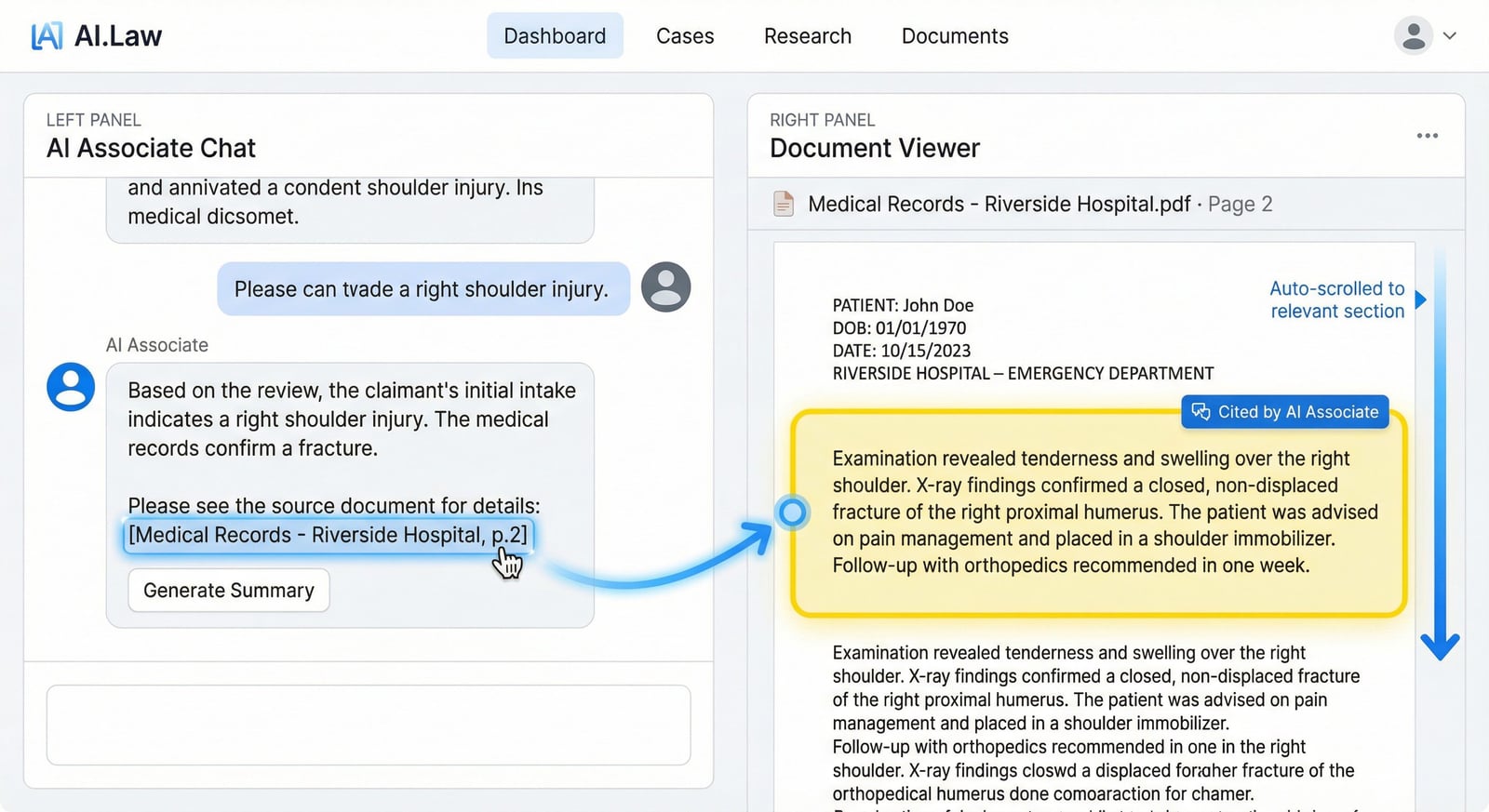
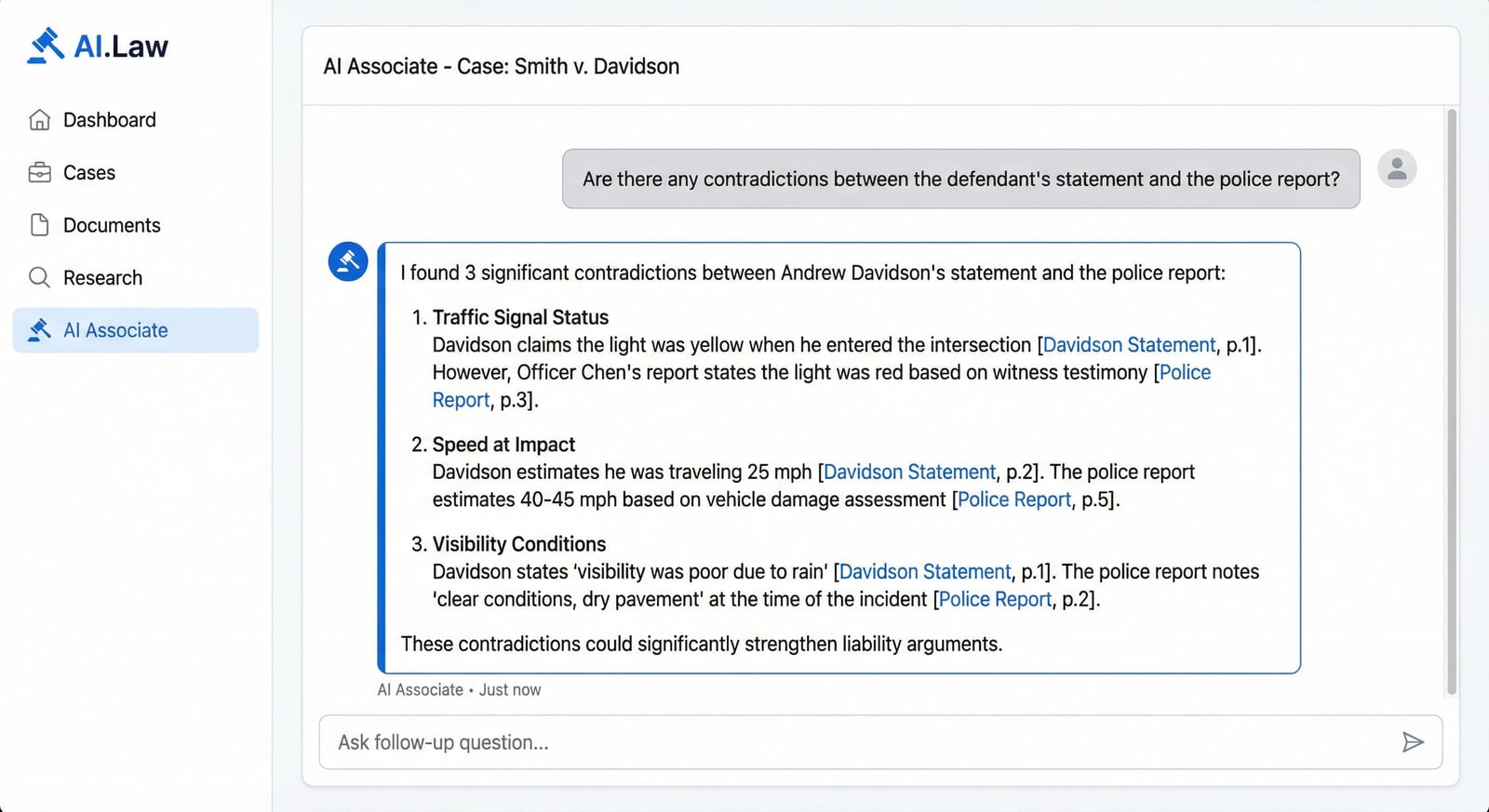
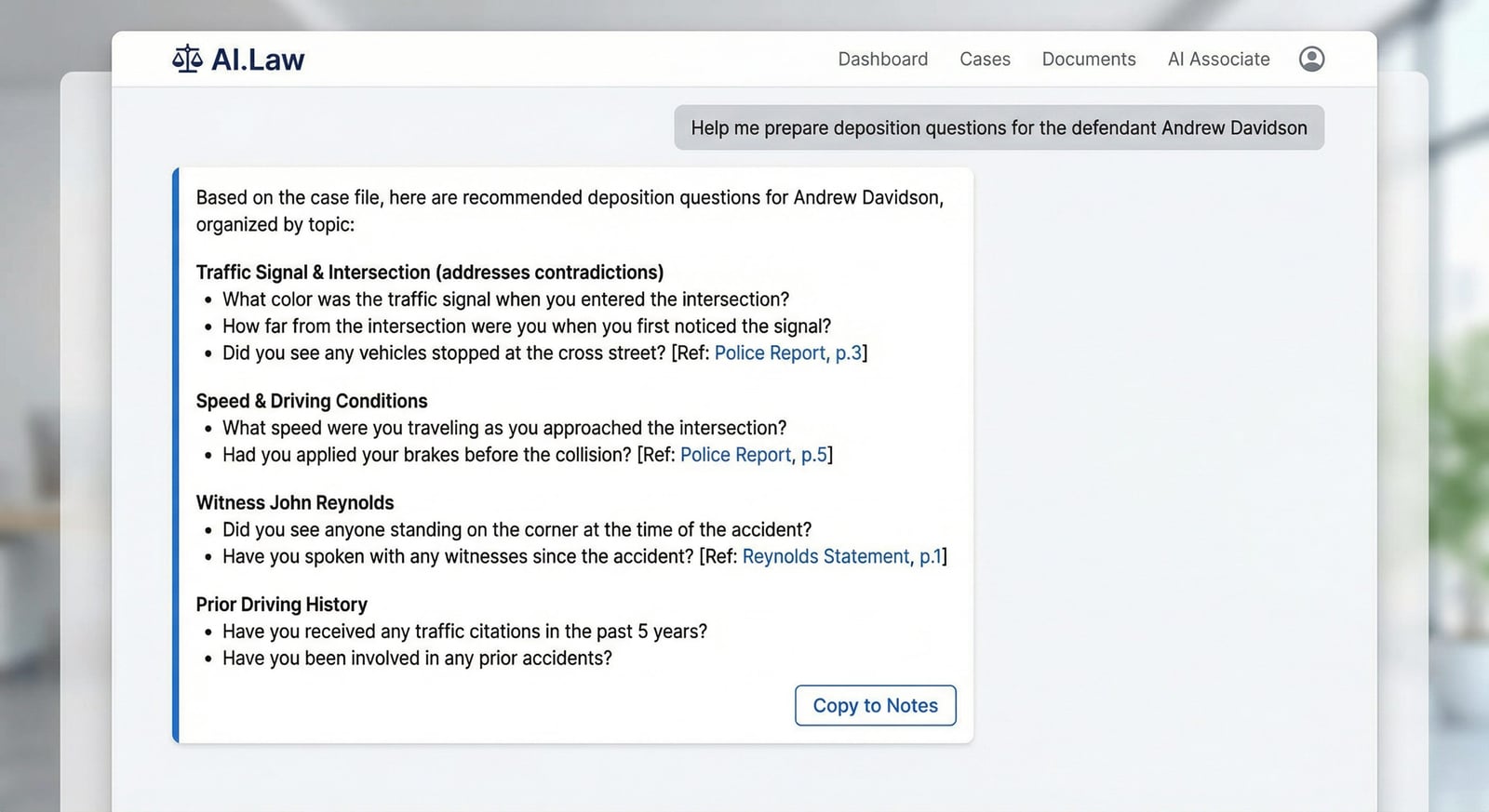
- Direct answer to the question in plain English, grounded in the matter record
- Clickable citations to the exact source document and passage supporting each key point
- Contradictions and inconsistencies identified across depositions, reports, emails, and discovery
- Document-to-document comparisons when two records describe the same event differently
- Calculated totals for bills, liens, wage loss, or timelines pulled from multiple sources
- Lists of missing information or likely follow-up questions when the record appears incomplete
- Matter-specific summaries of status, exposure, defenses, and next steps
- Choice of multiple AI models depending on whether you need speed, depth, or drafting quality
How It Works
Get started in minutes. No training required.
1. Open any matter
The AI Associate is ready on every matter’s landing page. Every uploaded document, extracted data point, and timeline event is automatically available. No setup, no file selection.
2. Ask your question
Type any question in plain English — factual queries, cross-references, contradictions, damage calculations, witness comparisons. Choose from 10 AI models or use the default.
3. Get cited answers
AI searches across every document in the matter and returns detailed answers with clickable citations. Click any citation to jump to the highlighted source passage.
4. Follow up and go deeper
Ask follow-up questions with full conversational context maintained. Drill into specific documents, compare sources, or request analysis on specific legal issues.
How attorneys use AI Associate
Real scenarios from litigation practice — not hypotheticals.
Finding contradictions before a deposition
The defendant testified in interrogatories that he had "the green light and never saw the plaintiff until impact." But the police report says an independent witness saw the defendant looking down at his phone, and the body-worn camera captures him saying, "I thought I could beat the yellow." You ask AI Associate to compare the interrogatory answers, crash report, body-cam transcript, and deposition outline you started last night. In seconds, it returns every inconsistent statement with citations to the exact page and line or document location. Instead of manually hunting for impeachment, you walk into the deposition with the contradictions already mapped.
Calculating damages from scattered source documents
Your matter has 19 medical bills, wage-loss documents from two employers, and a lien letter that arrived last week. The defense says your damages spreadsheet overstates specials. Rather than manually re-checking every source, you ask AI Associate: "Total the medical bills through June, exclude balances adjusted off by insurance, and compare that number to the last settlement package." It reads across the bills, EOBs, and prior settlement correspondence, then gives you the answer with citations showing exactly which document supports each figure. You can confirm the number in minutes instead of spending half a day rebuilding the spreadsheet.
Summarizing a matter after weeks away from the file
You have not looked at a trucking case in six weeks because you were in trial on something else. The client calls wanting an update in 20 minutes. You open the matter and ask AI Associate to summarize liability, treatment status, pending discovery issues, and next deadlines. It reads the pleadings, recent email traffic, medical updates, and scheduling order, then gives you a cited status report that lets you sound fully current on the call. Instead of reopening 40 tabs and trying to reconstruct the case history from memory, you are back on top of the file almost immediately.
Cross-checking discovery responses against the record
Opposing counsel served responses claiming they produced all incident photographs and all communications about the product recall. You suspect that is incomplete because one witness mentioned a second inspection and internal emails. AI Associate compares the discovery responses, produced documents, witness interviews, and email chains already in the matter. It flags what appears to be missing, points to the source references suggesting additional materials exist, and gives you a focused list of follow-up requests. That turns a vague suspicion into a documented deficiency analysis you can act on quickly.
More Detail
Cross-reference depositions against medical records, compare witness statements, find the fact buried on page 247
The AI Associate isn’t a generic chatbot with your files attached. It reads and cross-references every document in the matter — deposition transcripts, interrogatory answers, medical records, police reports, correspondence, billing statements, intake narratives — and answers questions that require synthesis across multiple sources. Ask "Does the plaintiff’s description of the accident at intake match the police report?" and get a side-by-side analysis with citations to both documents. Ask "What is the total of all physical therapy charges billed after the IME report date?" and get an itemized answer with provider names, dates, and amounts cited to the billing records.
- Cross-document analysis: compare deposition testimony against interrogatory answers, medical records against intake narratives, police reports against witness statements — contradictions surfaced with citations to both sources
- 10 AI models available — switch between GPT, Claude, Gemini, Perplexity, and AI.Law’s legal model depending on the question. Different models excel at different tasks — use the best one for each query
- Clickable citations on every answer — click any reference to jump directly to the highlighted passage in the source document for instant verification
- Questions grounded in your case data, not generic legal knowledge — the AI only answers from what’s actually in your case file, with citations to prove it
Faster
Prep for a 30(b)(6) deposition in 10 minutes — not 3 hours of file review
You’re deposing the corporate representative tomorrow. You need to know: what did the company produce in discovery about their inspection protocols, what did their fact witness say about maintenance schedules in his deposition, and does the incident report contradict the interrogatory answers about prior complaints? Without the AI Associate, that’s 3 hours of reading transcripts and cross-referencing documents. With the AI Associate, ask each question, get cited answers, and build your deposition outline in the time it takes to drink a cup of coffee.
- Ask "What did each witness say about the condition of the stairway?" — get a cited comparison across every deposition and statement in the matter
- Ask "List every medical provider who treated the plaintiff after the surgery" — get names, dates, and treatment types cited to the medical records
- Ask "Does the defendant’s answer to Interrogatory 7 contradict their deposition testimony at pages 45–48?" — get a direct comparison with both sources cited
- Follow-up questions maintain context — drill deeper into any answer without re-explaining the question or re-uploading documents
Easier
Embedded in every matter — your entire case file, accessible through a conversation
The AI Associate lives on every matter’s landing page. Every document you’ve uploaded, every data point extracted, every timeline event, every party identified — all automatically available without selecting files, without copy-pasting into a separate tool, without a separate login. Ask your question in plain English the way you’d ask a first-year associate sitting across the desk. The difference: this associate has read every page of every document and can find any fact in seconds.
- Embedded directly in each matter — no separate tool, no file selection, no setup. Open the matter and start asking.
- Natural language questions: "When did the plaintiff first report neck pain?" "What did the defense expert say about causation?" "Find every document that mentions the guardrail."
- 10 AI models accessible from a single dropdown — switch models mid-conversation to compare answers or use different strengths for different question types
- Every document type supported — medical records, depositions, discovery, police reports, emails, billing statements, contracts, expert reports — all searchable through the same conversation
More Money
The attorney who knows every fact in the file wins the case — the AI Associate makes that attorney you
The attorney who has read every page of every medical record, every line of every deposition, and every document produced in discovery has a decisive advantage in depositions, hearings, mediations, and trial. But on a caseload of 80+ matters, no human can maintain that level of familiarity with every case. The AI Associate gives you that advantage on every matter — instantly recalling any fact, any contradiction, any admission from thousands of pages of documents. Better-prepared attorneys negotiate higher settlements, win more motions, and impress judges. The AI Associate makes you the best-prepared attorney in every room.
- Spot contradictions between testimony and documents that create impeachment opportunities worth thousands in settlement leverage
- Find the overlooked admission on page 247 of a 300-page document production that changes the entire case evaluation
- Prepare for hearings, mediations, and depositions in minutes instead of hours — command every fact without scrambling through files
- Handle a larger caseload without sacrificing case knowledge — the AI Associate maintains perfect recall across every document in every matter
Stop searching through files — start asking questions and getting cited answers
See what changes when AI handles the work instead.
| Area | The Old Way | With AI.Law |
|---|---|---|
| Finding facts | Ctrl+F across dozens of PDFs, hoping the right keyword matches | Ask a natural language question, get a cited answer from every relevant document in seconds |
| Cross-referencing | Open two documents side by side and manually compare | Ask the AI to compare any two sources — depositions vs. interrogatories, records vs. testimony — with dual citations |
| Deposition prep | 3 hours reviewing records to build a question outline | Ask the AI Associate to identify key facts, contradictions, and knowledge gaps — depo-ready in 10 minutes |
| AI models | One model (ChatGPT) with no case document access | 10 models with automatic access to every document in the matter — no upload, no copy-paste |
| Verification | Manually hunting through files to find where a fact came from | Clickable citations on every answer — one click to the highlighted source passage |
AI Associate sits on top of the full matter record
AI Associate becomes powerful only because the rest of the platform has already organized the case. Documents are uploaded once into document management. Data extraction and the timeline tools structure what happened and when. Legal research gives you the governing standards. Then AI Associate lets you ask questions across all of it at once: what the record says, where the conflict is, what is still missing, and what to do next. It is not a separate knowledge base to maintain. It rides on top of the matter you are already building.
- Document Management — Store pleadings, records, transcripts, emails, and exhibits in one searchable matter file
- Data Extraction — Pull providers, bills, dates, parties, and other structured facts from the uploaded documents
- Legal Research — Confirm the legal standards and authorities that govern the issues in the matter
- AI Associate (this tool) — Ask case-specific questions across the full matter and get cited answers instantly
- Deposition Analysis — Turn identified contradictions and key admissions into witness-prep and impeachment work product
- Custom Reports — Package the insights into a memo, status report, or strategic summary for the file
Key concepts behind cited case analysis
Understanding the legal framework behind the tool helps you get more from it.
Impeachment by prior inconsistent statement
A witness can be impeached with a prior statement that conflicts with current testimony, whether the earlier statement came in a deposition, interrogatory answer, recorded interview, or document. The practical challenge is not the doctrine; it is locating every inconsistent version across a large matter file. AI Associate helps surface those inconsistencies quickly so the lawyer can decide which ones matter strategically.
Business records and source reliability
Not every document in a file carries the same evidentiary weight. Medical records, payroll records, and authenticated business emails are often treated differently from handwritten notes, unsworn statements, or attorney summaries. A cited answer is most valuable when you can evaluate not just what the source says, but how reliable and admissible that source is likely to be.
Chronology as a litigation tool
A chronology is more than a timeline of dates. It is a way to test causation, notice, diligence, treatment progression, and the sequence of key decisions in a case. When AI Associate answers a question by organizing facts chronologically, it helps lawyers see gaps, delays, and causal links that are easy to miss when records are reviewed document by document.
Document completeness and negative inferences
Sometimes the most important fact is what is missing. If a response claims all relevant communications were produced but the file refers to attachments or follow-up emails that are absent, that can support a deficiency letter or follow-up discovery. AI Associate can flag those signs of incompleteness, but the lawyer still decides whether the missing material matters enough to pursue.
Related tools for AI Associate
Same matter file, same uploads — keep working in this litigation workflow cluster.
- Switch to dedicated research mode with 10 AI models — Legal Research
- Cross-reference deposition answers against the file — Deposition Analysis
- Verify citations before filing your motion — Brief Analyzer & Citation Lookup
- Save and reuse your best prompts across matters — Personal Chat Libraries
Browse all Admin tools on the features hub, or see all features.
Free practice management. Pay only for AI you use.
Run your firm on Free Forever at $0 — CRM, calendar, billing, and document management for everyone. Add paid AI seats only for the people who need them, all on one plan for your firm: Core, Litigator, or Advanced.
- 11 tools free forever — no credit card required
- One plan for your firm — every paid seat on the same plan
- Cancel any paid seat anytime — no lock-in
- Annual billing: 12 months for the price of 11 on paid seats
- Free Forever practice management stays at $0
SOC 2 Type II Certified · Patented Technology · No AI Training on Your Data · You Own Your Data
Explore More
Your best prompts, organized and reusable — build a personal AI playbook that gets smarter with every case
Save, organize, and instantly reuse your most effective AI prompts across every matter. Build folders of proven conversation starters that deliver consistent results without rewriting from scratch.
Get started with AI Associate
Open a free practice management account, or build an AI plan when you’re ready.
No credit card required.
Need a firm or enterprise plan? Talk to our team