Evaluate dismissal risk before opposing counsel files the motion
AI.Law analyzes your complaint against Rule 12(b)(6) standards, identifies claims vulnerable to dismissal, flags pleading deficiencies under Iqbal/Twombly, and suggests amendments — before the motion to dismiss arrives. Know your weaknesses. Fix them first.
How Dismissal Analyzer works on a live matter
Dismissal Analyzer is the AI.Law tool civil litigators use for document, research, and case-strategy work. Most attorneys discover their complaint's weaknesses when the motion to dismiss lands. By then, you are on defense — researching the standard, drafting the opposition, and hoping the court gives leave to amend. AI.Law gives you the vulnerability analysis before you file, so you can fix the problems preemptively.
On a live matter it runs in 4 steps: (1) Upload your complaint, (2) AI evaluates each claim, (3) Review the vulnerability report, (4) Amend and re-analyze. Add the draft or filed complaint to your matter. AI.Law parses every cause of action and factual allegation.
After Iqbal and Twombly, conclusory allegations are not enough. Every factual allegation must plausibly support every element of every claim. AI.Law reads your complaint, identifies the elements required for each cause of action, and evaluates whether your factual allegations meet the plausibility standard — flagging claims that are vulnerable to a 12(b)(6) motion and suggesting specific amendments to cure the deficiencies. Each cause of action evaluated against its required elements — duty, breach, causation, damages for negligence; offer, acceptance, consideration, breach for contract.
Complete vulnerability analysis in minutes after drafting the complaint. No legal research required — AI knows the elements of common causes of action and the applicable pleading standard. Each output cites the source pages in your matter so you can verify it before you file.
What you get from Dismissal Analyzer
Every Dismissal Analyzer run is grounded in your uploaded matter — not a blank chat prompt. Here is what attorneys use on real cases:
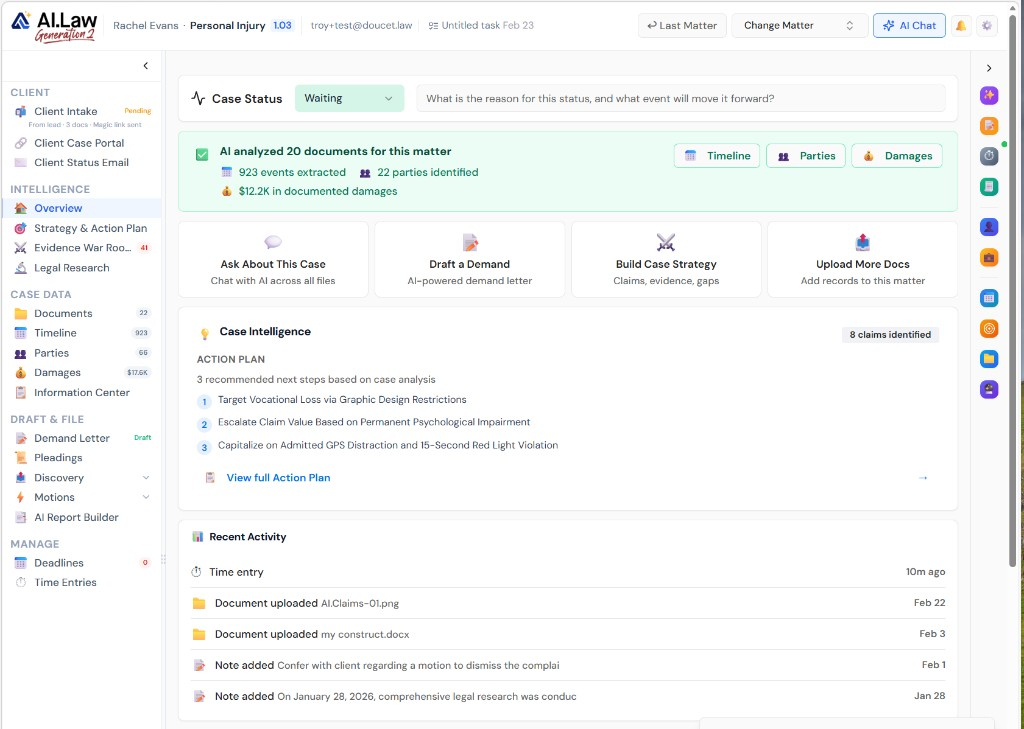
- Each cause of action evaluated against its required elements — duty, breach, causation, damages for negligence; offer, acceptance, consideration, breach for contract
- Factual allegations mapped to claim elements — identifying where you have plausible factual support and where allegations are conclusory
- Specific amendment suggestions for vulnerable claims — additional factual allegations that would survive a motion to dismiss
- Standing, jurisdiction, and statute of limitations issues flagged alongside the substantive pleading analysis
- Complete vulnerability analysis in minutes after drafting the complaint
- Fix pleading deficiencies before filing — not after a 12(b)(6) motion forces the issue
- No legal research required — AI knows the elements of common causes of action and the applicable pleading standard
- Structured report: each claim rated by vulnerability with specific deficiencies and suggested fixes
How It Works
Get started in minutes. No training required.
1. Upload your complaint
Add the draft or filed complaint to your matter. AI.Law parses every cause of action and factual allegation.
2. AI evaluates each claim
Each cause of action is evaluated against its required elements under the applicable pleading standard — Iqbal/Twombly for federal, state-specific standards where applicable.
3. Review the vulnerability report
Get a claim-by-claim analysis showing which are strong, which are vulnerable, and what specific factual allegations would cure the deficiencies.
4. Amend and re-analyze
Make amendments based on the suggestions, re-upload, and run the analysis again to verify the complaint now survives the plausibility standard.
More Detail
Claim-by-claim vulnerability analysis under the plausibility pleading standard
After Iqbal and Twombly, conclusory allegations are not enough. Every factual allegation must plausibly support every element of every claim. AI.Law reads your complaint, identifies the elements required for each cause of action, and evaluates whether your factual allegations meet the plausibility standard — flagging claims that are vulnerable to a 12(b)(6) motion and suggesting specific amendments to cure the deficiencies.
- Each cause of action evaluated against its required elements — duty, breach, causation, damages for negligence; offer, acceptance, consideration, breach for contract
- Factual allegations mapped to claim elements — identifying where you have plausible factual support and where allegations are conclusory
- Specific amendment suggestions for vulnerable claims — additional factual allegations that would survive a motion to dismiss
- Standing, jurisdiction, and statute of limitations issues flagged alongside the substantive pleading analysis
Faster
Know your complaint's vulnerabilities in minutes — not when the motion to dismiss arrives
Most attorneys discover their complaint's weaknesses when the motion to dismiss lands. By then, you are on defense — researching the standard, drafting the opposition, and hoping the court gives leave to amend. AI.Law gives you the vulnerability analysis before you file, so you can fix the problems preemptively.
- Complete vulnerability analysis in minutes after drafting the complaint
- Fix pleading deficiencies before filing — not after a 12(b)(6) motion forces the issue
- Amendment suggestions include specific factual allegations that would cure identified deficiencies
- Run the analysis again after amendments to verify the complaint now survives the plausibility standard
Easier
Upload the complaint — AI evaluates every claim against the dismissal standard
Upload your draft complaint. AI.Law reads every cause of action, identifies the required elements, and evaluates whether your factual allegations plausibly support each one. You get a structured report showing which claims are strong, which are vulnerable, and what to add.
- No legal research required — AI knows the elements of common causes of action and the applicable pleading standard
- Structured report: each claim rated by vulnerability with specific deficiencies and suggested fixes
- Useful for both plaintiff-side (before filing) and defense-side (evaluating whether to file a 12(b)(6) motion)
- Share the analysis with co-counsel or the client as part of case evaluation
More Money
Surviving the motion to dismiss is the first battle — win it before it is filed
A dismissed claim is a lost claim. Even if the court grants leave to amend, you have lost time, momentum, and credibility. AI.Law's dismissal analyzer lets you file a complaint that survives the first challenge — keeping all your claims alive and your case on track toward discovery and resolution.
- Keep all claims alive through the motion to dismiss stage — preserving leverage for settlement and discovery
- Avoid the delay and expense of amended complaints and second rounds of motion practice
- Defense-side analysis identifies which claims are worth moving to dismiss — and which motions are likely to fail
- Better pleadings from the start lead to stronger cases and better outcomes
Stop discovering your complaint's weaknesses from the motion to dismiss
See what changes when AI handles the work instead.
| Area | The Old Way | With AI.Law |
|---|---|---|
| Timing | Learn about pleading deficiencies when the 12(b)(6) motion arrives | Vulnerability analysis available in minutes — before you file the complaint |
| Analysis | Attorney self-reviews or relies on co-counsel to spot issues | Systematic claim-by-claim evaluation against required elements and pleading standard |
| Amendments | File amended complaint after motion to dismiss — with court leave required | Fix deficiencies preemptively — file a complaint that survives the first challenge |
| Defense use | Attorney reads complaint and identifies potential 12(b)(6) arguments manually | Systematic analysis identifies which claims are vulnerable — and how strong the motion would be |
| Outcome | Risk losing claims at the pleading stage | All claims survive because deficiencies were cured before filing |
Related tools for Dismissal Analyzer
Same matter file, same uploads — keep working in this litigation workflow cluster.
- Draft complaints built to survive 12(b)(6) scrutiny — Lawsuit Drafting
- File dismissal motions with plausibility analysis — Motion Drafting
- Spot weak claims before opposing counsel does — Issue Spotter
Browse all Admin tools on the features hub, or see all features.
Free practice management. Pay only for AI you use.
Run your firm on Free Forever at $0 — CRM, calendar, billing, and document management for everyone. Add paid AI seats only for the people who need them, all on one plan for your firm: Core, Litigator, or Advanced.
- 11 tools free forever — no credit card required
- One plan for your firm — every paid seat on the same plan
- Cancel any paid seat anytime — no lock-in
- Annual billing: 12 months for the price of 11 on paid seats
- Free Forever practice management stays at $0
SOC 2 Type II Certified · Patented Technology · No AI Training on Your Data · You Own Your Data
Explore More
Convert recordings to searchable text — depositions, hearings, client calls
Upload video or audio files and AI.Law converts them to searchable, timestamped transcripts. Deposition videos, client intake calls, hearing recordings, witness interviews, and expert consultations — all converted to text that feeds into AI analysis, deposition comparison, and case documents.
Get started with Dismissal Analyzer
Open a free practice management account, or build an AI plan when you’re ready.
No credit card required.
Need a firm or enterprise plan? Talk to our team