Every provider, treatment, diagnosis, and cost — extracted with page citations
AI.Law reads every page of your uploaded medical records — ER visits, MRI reports, orthopedic consultations, physical therapy notes, surgical records, billing statements — and generates a structured analysis with treatment timelines, total costs by provider, causation links to the incident, and pre-existing condition identification. Every finding cited to the specific page.
How Medical Analysis works on a live matter
Medical Analysis is the AI.Law tool civil litigators use for medical-record and damages review. A paralegal reviewing a stack of medical records can take days or weeks to produce a comprehensive summary. AI.Law processes every page simultaneously and delivers a structured analysis report — with costs, providers, treatments, and causation — in minutes.
On a live matter it runs in 4 steps: (1) Upload medical records, (2) AI generates the analysis, (3) Review the report, (4) Use across your case. Add medical records to your matter in any format. AI.Law converts, processes, and reads every page.
Your client has 1,400 pages of medical records across 8 providers spanning 3 years of treatment. Somewhere in those records are the total medical specials, the causation opinions, the pre-existing conditions the defense will use, and the future treatment recommendations you need for settlement correspondence. A paralegal takes two weeks. AI.Law reads every page simultaneously — extracting every provider visit, every diagnosis code, every procedure, every charge — and produces a structured analysis with page citations for every finding. Treatment timeline: every ER visit, consultation, surgery, injection, PT session, and follow-up — chronologically organized with dates, providers, and findings.
Upload medical records and get a complete analysis report in minutes. Upload records in any format — PDF, images, faxes — AI handles conversion and analysis. Each output cites the source pages in your matter so you can verify it before you file.
What your medical analysis report contains
AI.Law produces a comprehensive medical analysis from your uploaded records — not a summary of summaries, but a provider-by-provider, visit-by-visit analysis with citations to the source pages.
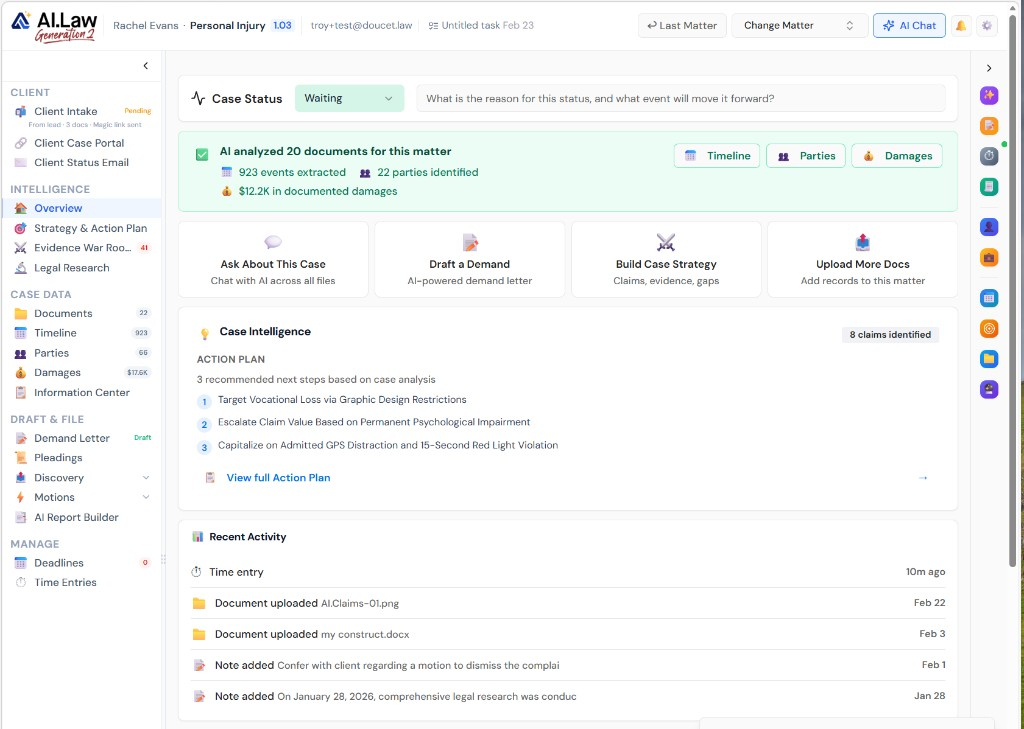
- Provider directory listing every medical professional, facility, and their role in the patient's care
- Visit-by-visit chronology with date, provider, subjective complaints, objective findings, assessment, and plan
- Diagnosis timeline showing when each condition was first identified and by whom
- Treatment summary organized by type: surgical procedures, injections, imaging, physical therapy, medications
- Cost breakdown by provider with billed amounts, insurance adjustments, and patient responsibility
- Causation analysis connecting the incident to documented injuries with supporting medical evidence
- Treatment gap identification with duration and potential explanations to address proactively
- Page citations for every extracted data point — click through to the exact page in the source records
How It Works
Get started in minutes. No training required.
1. Upload medical records
Add medical records to your matter in any format. AI.Law converts, processes, and reads every page.
2. AI generates the analysis
AI extracts providers, treatments, diagnoses, costs, and causation factors into a structured report with page citations.
3. Review the report
Get a complete medical analysis with treatment timeline, cost summary, provider list, and causation analysis.
4. Use across your case
Export for settlement correspondence, feed into AI-generated medical illustrations, or use for mediation and trial preparation.
How attorneys use Medical Analysis
Real scenarios from litigation practice — not hypotheticals.
MVA with 400+ pages from 12 providers
Your client was in a highway collision and treated at the ER, followed by her primary care physician, an orthopedic surgeon, a pain management specialist, a physical therapist, a chiropractor, and a neurologist — plus diagnostic imaging at three different facilities. You have 423 pages of medical records and your medical chronology is due in three weeks. A paralegal would spend 15-20 hours building the chronology manually, cross-referencing provider notes against imaging reports and billing records. AI.Law reads every page, identifies each provider, maps every visit on a timeline, extracts diagnoses and procedure codes, and presents a complete medical analysis — organized by provider and by date — with page citations back to the source records. Your paralegal reviews the output in two hours instead of building it from scratch in two weeks.
Identifying gaps in treatment the defense will exploit
Your client stopped treating for four months between her chiropractor releasing her and her orthopedic surgeon ordering the MRI that revealed the disc herniation. The defense will argue the gap proves she wasn't really hurt — or that something else caused the herniation during those four months. AI.Law's medical analysis flags the treatment gap automatically, giving you the chance to address it proactively. You talk to your client and learn she stopped treating because her PIP benefits exhausted and she couldn't afford to pay out of pocket — a sympathetic explanation you can present in settlement correspondence before the adjuster ever raises the issue.
Workers' comp with multiple IMEs and treating physicians
The employer's insurer sent your client to three independent medical examiners over 18 months, each with a different opinion on causation and disability rating. Meanwhile, two treating physicians and a functional capacity evaluator have their own conclusions. AI.Law's medical analysis organizes all of these opinions side by side — what each physician found, what they concluded about causation, and how their opinions differ. Instead of flipping between six different reports trying to reconcile conflicting conclusions, you have a single summary that shows exactly where the IME doctors diverge from the treating physicians and on what specific points.
Medical malpractice — identifying standard of care deviations
You suspect a delayed cancer diagnosis. Your client saw her primary care physician three times over eight months with complaints of persistent fatigue, unexplained weight loss, and a palpable abdominal mass. Each time, the physician attributed the symptoms to stress and prescribed rest. AI.Law's medical analysis extracts every complaint, every finding, and every action taken at each visit — building a timeline that makes the pattern visible. When the oncologist finally diagnosed Stage III ovarian cancer, the analysis shows exactly which visits presented red flags that should have prompted further workup, giving your medical expert a clear foundation for the standard of care opinion.
More Detail
Complete medical chronology with costs, causation, and pre-existing condition analysis
Your client has 1,400 pages of medical records across 8 providers spanning 3 years of treatment. Somewhere in those records are the total medical specials, the causation opinions, the pre-existing conditions the defense will use, and the future treatment recommendations you need for settlement correspondence. A paralegal takes two weeks. AI.Law reads every page simultaneously — extracting every provider visit, every diagnosis code, every procedure, every charge — and produces a structured analysis with page citations for every finding.
- Treatment timeline: every ER visit, consultation, surgery, injection, PT session, and follow-up — chronologically organized with dates, providers, and findings
- Cost analysis: total medical specials calculated with per-provider and per-procedure breakdowns, distinguishing billed charges from paid amounts where available
- Causation mapping: AI identifies which injuries and treatments are causally linked to the incident — and flags pre-existing conditions and prior treatment that the defense will raise
- Future treatment: recommendations for future care extracted from physician notes — supporting future medical damages in settlement correspondence
Faster
Thousands of pages analyzed in minutes — not weeks
A paralegal reviewing a stack of medical records can take days or weeks to produce a comprehensive summary. AI.Law processes every page simultaneously and delivers a structured analysis report — with costs, providers, treatments, and causation — in minutes.
- Upload medical records and get a complete analysis report in minutes
- Thousands of pages processed simultaneously — no page-by-page manual review
- Every finding cited with specific page numbers for instant verification
- Updated automatically as new records are added to the matter
Easier
Upload records — AI builds the analysis
No special formatting, no coding, no template setup. Upload medical records in any format and AI.Law generates a structured analysis report. Ask follow-up questions about specific treatments, providers, or dates in natural language.
- Upload records in any format — PDF, images, faxes — AI handles conversion and analysis
- Ask natural-language questions about specific injuries, treatments, or providers
- Export analysis reports for settlement correspondence, mediation summaries, or trial preparation
- Reports update automatically as new medical records are added to the case
More Money
Better medical analysis means higher settlement values
Complete command of the medical evidence is the difference between a good settlement and a great one. AI.Law ensures no treatment is missed, no cost is overlooked, and every causation link is documented — giving you the ammunition for maximum recovery.
- No missed medical costs — AI catches every charge across all providers
- Stronger causation analysis supports higher damages arguments in settlement correspondence
- Eliminate paralegal hours spent on manual medical record review
- Complete analysis on every case — not just the high-value ones that justify the review time
Stop spending weeks on medical record review
See what changes when AI handles the work instead.
| Area | The Old Way | With AI.Law |
|---|---|---|
| Review time | Days or weeks for a paralegal to review records | Complete analysis with page citations in minutes |
| Cost extraction | Manually tally costs from bills and EOBs | Every cost extracted and totaled automatically with per-provider breakdowns |
| Causation | Attorney reads records and builds causation narrative | AI identifies causation links and distinguishes pre-existing conditions |
| Completeness | Human reviewers miss details in long record sets | Every page read — no provider, treatment, or cost overlooked |
| Updates | Re-review everything when new records arrive | Analysis updates automatically as new records are added |
Medical analysis is the foundation that every litigation tool builds on
Medical analysis sits at the center of a personal injury case. Once your records are uploaded and data extraction has pulled out the raw information — providers, bills, dates, diagnoses — the medical analysis tool synthesizes it into a coherent narrative. That narrative flows directly into settlement correspondence as the medical chronology section. The medical illustrations tool uses the same diagnoses and procedures to generate anatomical visuals. If the case goes to litigation, the analysis feeds your deposition preparation — you know exactly which providers treated what conditions and where the defense IME opinions diverge. Every tool downstream is only as good as the medical analysis upstream.
- Document Management — Upload medical records, imaging reports, and billing statements
- Data Extraction — Extract providers, diagnoses, CPT codes, costs, and dates from every page
- Medical Analysis (this tool) — Build the provider-by-provider chronology and causation analysis
- Medical Illustrations — Generate anatomical visuals from the documented injuries
- Medical Illustrations — Generate anatomical visuals from documented injuries
- Deposition Analysis — Cross-reference treating physician testimony against the medical records
Key medical-legal concepts in record analysis
Understanding the legal framework behind the tool helps you get more from it.
Causation: proximate cause vs. but-for
Establishing medical causation requires showing that the incident was both the but-for cause (the injury would not have occurred without the incident) and the proximate cause (the injury was a foreseeable result). In practice, this means the medical records must document a temporal connection between the incident and the onset of symptoms, supported by diagnostic findings and treating physician opinions that attribute the condition to the incident rather than pre-existing disease or intervening events.
Daubert and Frye standards for expert testimony
Medical expert opinions must satisfy the applicable admissibility standard — Daubert (federal courts and most states) requires that the methodology be testable, peer-reviewed, and generally accepted, while Frye (still used in some states like California, Illinois, and New York) focuses solely on general acceptance in the relevant scientific community. A thorough medical record analysis identifies the facts the expert will rely upon and ensures they are documented in the records — not just recounted by the client.
Treatment gaps and their impact on case value
A gap in treatment — even 30 days — gives the defense an argument that the plaintiff was not in significant pain or that an intervening event caused the symptoms. Common legitimate explanations include exhaustion of insurance benefits, inability to pay copays, work schedule conflicts, or physician-directed "wait and see" periods. Identifying gaps early allows the attorney to develop the explanation and present it proactively rather than reactively.
Independent medical examinations (IMEs)
Defense IMEs are adversarial evaluations designed to minimize the plaintiff's injuries. The examining physician typically spends 15-30 minutes with the patient and often reaches conclusions that conflict with months of treatment by the plaintiff's own physicians. Effective medical analysis compares IME findings against the full treatment record — identifying where the IME doctor ignored documented objective findings, failed to review all records, or reached conclusions inconsistent with the diagnostic imaging.
Related tools for Medical Analysis
Same matter file, same uploads — keep working in this litigation workflow cluster.
- Generate injury illustrations from the same medical records — Medical Illustrations
- Extract billing lines and treatment timelines automatically — Data Extraction
- Pull custom damages fields your firm tracks on every case — Custom Field Extraction
- Draft complaints with medical facts from chronologies — Lawsuit Drafting
Browse all Medical tools on the features hub, or see all features.
Free practice management. Pay only for AI you use.
Run your firm on Free Forever at $0 — CRM, calendar, billing, and document management for everyone. Add paid AI seats only for the people who need them, all on one plan for your firm: Core, Litigator, or Advanced.
- 11 tools free forever — no credit card required
- One plan for your firm — every paid seat on the same plan
- Cancel any paid seat anytime — no lock-in
- Annual billing: 12 months for the price of 11 on paid seats
- Free Forever practice management stays at $0
SOC 2 Type II Certified · Patented Technology · No AI Training on Your Data · You Own Your Data
Explore More
AI-generated medical illustrations from your case records — unique to AI.Law
Cervical disc herniations, lumbar fusions, rotator cuff tears, TBI impact zones — AI.Law generates custom medical illustrations directly from your uploaded medical records. Embedded in settlement correspondence, used at mediation, presented at trial. No medical illustrator. No $2,000 invoice. No 3-week wait.
Get started with Medical Analysis
Open a free practice management account, or build an AI plan when you’re ready.
No credit card required.
Need a firm or enterprise plan? Talk to our team