AI extracts coverage details, policy limits, reservation of rights, and coverage gaps from insurance documents in minutes
Upload insurance policies, declarations pages, reservation of rights letters, and coverage correspondence — AI.Law extracts every coverage detail, identifies applicable limits, maps coverage to your claims, flags reservation of rights language, and identifies potential coverage gaps or bad faith indicators. A 50-page policy becomes an actionable coverage summary in minutes.
How Insurance Reports works on a live matter
Insurance Reports is the AI.Law tool civil litigators use for medical-record and damages review. An attorney reviewing a 50-page commercial general liability policy to identify applicable coverages, limits, and exclusions typically spends 1–2 hours. Add a reservation of rights letter and coverage correspondence, and the review extends to half a day. AI.Law reads everything — policy, dec page, ROR letter, and correspondence — and delivers a structured analysis in minutes. The attorney reviews the summary, verifies the critical points, and has a complete coverage picture.
On a live matter it runs in 4 steps: (1) Upload insurance documents, (2) AI extracts coverage details, (3) Review the coverage summary, (4) Use the intelligence. Upload the policy, declarations page, endorsements, reservation of rights letter, or coverage correspondence to the matter.
Reading a 50-page insurance policy to find the applicable coverage, understand the exclusions, identify the reservation of rights language, and determine whether the limits are per-occurrence or aggregate is tedious, time-consuming, and easy to get wrong. AI.Law reads the entire policy, extracts every relevant data point, and presents a structured coverage summary: named insureds, policy period, coverage types with limits, deductibles, exclusions, endorsements, and conditions. Cross-referenced against the claims in your case so you know immediately which coverages apply and where gaps exist. Complete coverage extraction: named insured, policy period, coverage types, limits (per-occurrence and aggregate), deductibles, and SIR amounts.
Complete policy analysis in minutes — every coverage, limit, exclusion, and condition extracted and organized. Upload any insurance document: policy, dec page, endorsements, ROR letter, denial letter, or coverage correspondence. Each output cites the source pages in your matter so you can verify it before you file.
What you get from Insurance Reports
Every Insurance Reports run is grounded in your uploaded matter — not a blank chat prompt. Here is what attorneys use on real cases:
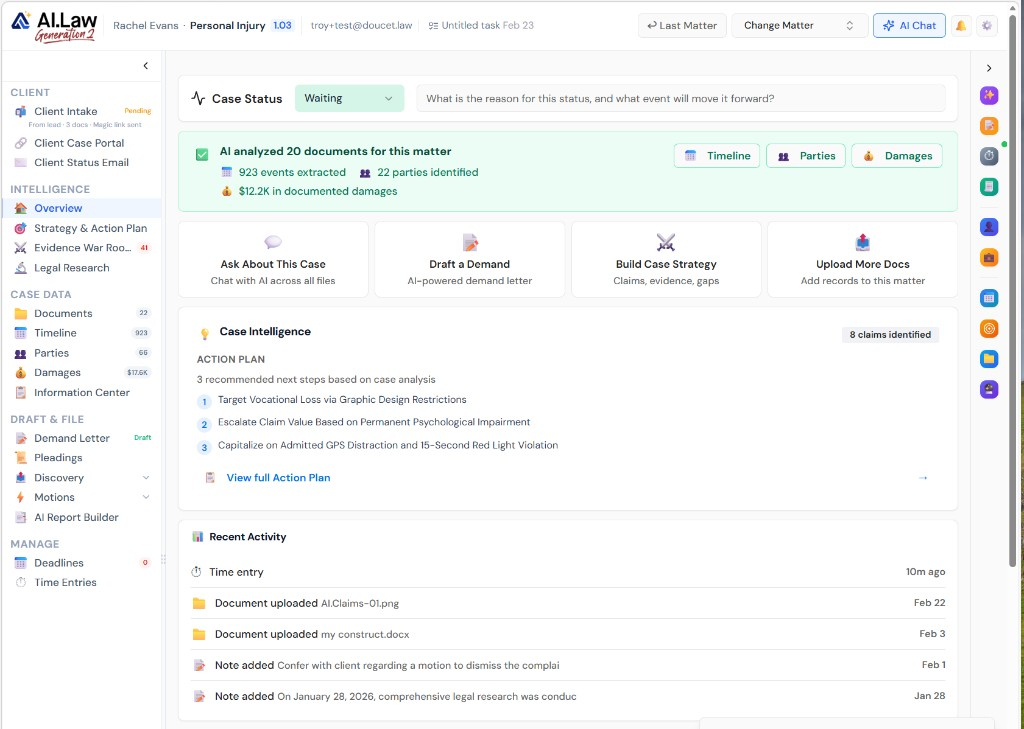
- Complete coverage extraction: named insured, policy period, coverage types, limits (per-occurrence and aggregate), deductibles, and SIR amounts
- Exclusion identification: AI flags every exclusion with plain-language explanation of what it excludes and whether it potentially applies to your claims
- Reservation of rights analysis: AI identifies the specific grounds the carrier reserved on and maps them to coverage provisions in the policy
- Coverage-to-claims mapping: AI cross-references extracted coverages against the claims in your case to identify which coverages are triggered and where gaps exist
- Complete policy analysis in minutes — every coverage, limit, exclusion, and condition extracted and organized
- Multi-document analysis: upload the policy, dec page, endorsements, and ROR letter together — AI synthesizes everything into one coverage picture
- Upload any insurance document: policy, dec page, endorsements, ROR letter, denial letter, or coverage correspondence
- Structured output organized by coverage type with limits, deductibles, and applicability to your claims
How It Works
Get started in minutes. No training required.
1. Upload insurance documents
Upload the policy, declarations page, endorsements, reservation of rights letter, or coverage correspondence to the matter.
2. AI extracts coverage details
AI reads every document and extracts coverages, limits, deductibles, exclusions, endorsements, conditions, and reservation of rights language.
3. Review the coverage summary
Get a structured summary organized by coverage type with limits, applicability to your claims, exclusion flags, and ROR analysis.
4. Use the intelligence
Export coverage summaries for settlement correspondence, map the coverage tower for case strategy, and identify bad faith indicators for potential additional claims.
More Detail
Coverage intelligence extracted from the actual policy — not assumptions based on carrier name
Reading a 50-page insurance policy to find the applicable coverage, understand the exclusions, identify the reservation of rights language, and determine whether the limits are per-occurrence or aggregate is tedious, time-consuming, and easy to get wrong. AI.Law reads the entire policy, extracts every relevant data point, and presents a structured coverage summary: named insureds, policy period, coverage types with limits, deductibles, exclusions, endorsements, and conditions. Cross-referenced against the claims in your case so you know immediately which coverages apply and where gaps exist.
- Complete coverage extraction: named insured, policy period, coverage types, limits (per-occurrence and aggregate), deductibles, and SIR amounts
- Exclusion identification: AI flags every exclusion with plain-language explanation of what it excludes and whether it potentially applies to your claims
- Reservation of rights analysis: AI identifies the specific grounds the carrier reserved on and maps them to coverage provisions in the policy
- Coverage-to-claims mapping: AI cross-references extracted coverages against the claims in your case to identify which coverages are triggered and where gaps exist
Faster
Policy analysis in minutes — not the 2 hours of reading it usually takes
An attorney reviewing a 50-page commercial general liability policy to identify applicable coverages, limits, and exclusions typically spends 1–2 hours. Add a reservation of rights letter and coverage correspondence, and the review extends to half a day. AI.Law reads everything — policy, dec page, ROR letter, and correspondence — and delivers a structured analysis in minutes. The attorney reviews the summary, verifies the critical points, and has a complete coverage picture.
- Complete policy analysis in minutes — every coverage, limit, exclusion, and condition extracted and organized
- Multi-document analysis: upload the policy, dec page, endorsements, and ROR letter together — AI synthesizes everything into one coverage picture
- Side-by-side comparison of multiple policies (primary, excess, umbrella) to map the coverage tower
- Exportable coverage summary for settlement correspondence, mediation statements, and case strategy documents
Easier
Upload the policy — AI produces a structured coverage summary you can actually use
No insurance coverage expertise required to get started. Upload the documents and AI.Law produces a structured summary organized by coverage type. Attorneys who handle coverage disputes regularly can drill into the detail. Attorneys who just need to know the limits and applicable coverages get a clear, plain-language summary. The analysis adapts to the complexity of the question.
- Upload any insurance document: policy, dec page, endorsements, ROR letter, denial letter, or coverage correspondence
- Structured output organized by coverage type with limits, deductibles, and applicability to your claims
- Plain-language exclusion summaries: understand what each exclusion means without parsing policy language
- Flag bad faith indicators: unreasonable delays, unsupported denials, and failure to investigate identified automatically
More Money
Knowing the real coverage picture changes your case strategy and demand calculus
You cannot evaluate settlement authority effectively if you do not understand the coverage tower. You cannot identify bad faith if you have not read the reservation of rights letter carefully. AI-powered insurance analysis gives you the complete coverage picture in minutes — so your strategy accounts for limits, coverage gaps, and bad faith indicators grounded in the actual policy language.
- Settlement correspondence calibrated to actual policy limits — pursue the right amount from the right coverage
- Coverage gap identification opens conversations about excess carriers, umbrella policies, or underinsured motorist coverage
- Bad faith identification: ROR analysis that identifies grounds for bad faith claims when carriers deny or delay unreasonably
- Multiple policy analysis: primary, excess, and umbrella coverages mapped together to understand the full tower
Stop spending 2 hours reading insurance policies to find the limits page
See what changes when AI handles the work instead.
| Area | The Old Way | With AI.Law |
|---|---|---|
| Policy review | 1–2 hours reading a 50-page policy to find applicable coverages | Complete coverage extraction with limits, exclusions, and conditions in minutes |
| Exclusion analysis | Read and interpret dense policy language — easy to miss relevant exclusions | Every exclusion identified with plain-language explanation and applicability flag |
| ROR analysis | Read the ROR letter, cross-reference against policy provisions — half a day | AI maps ROR language to specific policy provisions and identifies bad faith indicators |
| Coverage tower | Manually compare primary, excess, and umbrella policies — error-prone and slow | Upload all policies and AI maps the complete coverage tower automatically |
| Demand preparation | Demand amount based on general knowledge of “typical” limits for this carrier | Demands calibrated to actual extracted limits, deductibles, and coverage applicability |
Related tools for Insurance Reports
Same matter file, same uploads — keep working in this litigation workflow cluster.
- Pair coverage analysis with treatment chronologies — Medical Analysis
- Extract policy limits and reservation-of-rights language — Data Extraction
- Define custom coverage fields extracted on every upload — Custom Field Extraction
Browse all Medical tools on the features hub, or see all features.
Free practice management. Pay only for AI you use.
Run your firm on Free Forever at $0 — CRM, calendar, billing, and document management for everyone. Add paid AI seats only for the people who need them, all on one plan for your firm: Core, Litigator, or Advanced.
- 11 tools free forever — no credit card required
- One plan for your firm — every paid seat on the same plan
- Cancel any paid seat anytime — no lock-in
- Annual billing: 12 months for the price of 11 on paid seats
- Free Forever practice management stays at $0
SOC 2 Type II Certified · Patented Technology · No AI Training on Your Data · You Own Your Data
Explore More
Extract any data point from any document type — define the fields your practice needs and AI pulls them automatically
AI.Law’s extraction engine is not limited to pre-built fields. Define any data point your practice requires — specific policy numbers, treatment dates, provider names, billing codes, contract terms, or compliance deadlines — and AI extracts them from every document you upload. Your firm’s unique data needs met by an extraction engine that adapts to you.
Get started with Insurance Reports
Open a free practice management account, or build an AI plan when you’re ready.
No credit card required.
Need a firm or enterprise plan? Talk to our team