Your firm has already solved thousands of conflicts
Conflict Clear remembers every one of them. This conflict check software for law firms finds prior determinations, waiver language, engagement terms, and substantially similar matters — then explains why they mattered, so conflicts professionals spend less time searching and more time deciding. Built for directors of conflicts, conflicts counsel, new-business-intake teams, general counsel, chief risk officers, and innovation partners.
Included in Free Forever — practice management at $0. Add paid AI seats when you need them. See pricing
How Conflict Checks works on a live matter
Conflict Checks is the AI.Law tool civil litigators use for intake, lead tracking, and conflict screening. Manual conflict search means reading every name hit against every matter and deciding relevance from memory. AI conflict intelligence ranks results by real risk, groups them by concern, and surfaces the supporting documents — so conflicts counsel reach a defensible answer in minutes, not hours, and partners are interrupted only for issues that genuinely need them.
On a live matter it runs in 4 steps: (1) Enter the proposed representation, (2) AI screens firmwide, (3) Review ranked results — sources one click away, (4) A human decides, documents, and exports. Add the proposed client and adverse parties — or upload the complaint, engagement letter, outside counsel guidelines (OCG), or K-1 filings. AI extracts every name and entity automatically. No new client or matter required.
Legacy conflict check software returns 300 name hits and leaves your team to sort the relevant from the noise. AI.Law is different: it scores how strong each match is, classifies the relationship — current client, former client, affiliate, parent, subsidiary, insurer, expert, witness, beneficial owner, prior adverse party — and tells you which matches actually warrant review. Current-client adversity is flagged immediately, regardless of subject matter, and former-client matches get a substantial-relationship analysis under ABA Model Rule 1.9 with a plain-English rationale. Human in the loop, always: AI sources, distills, and summarizes the potential conflicts, but a human makes the decision — and every input behind a recommendation is one click from validation. AI.Law combines AI with deterministic non-AI processes so results are grounded in your firm's own records and avoid hallucinations altogether. Current client adversity alerts — direct adversity to a current client is flagged firmwide, instantly.
Results grouped by concern — current-client, former-client / substantial-relationship, related-entity, and low-relevance.
What you get from Conflict Checks
Every Conflict Checks run is grounded in your uploaded matter — not a blank chat prompt. Here is what attorneys use on real cases:
- Current client adversity alerts — direct adversity to a current client is flagged firmwide, instantly
- Substantial relationship analysis for former clients — AI scores High / Moderate / Low under Rule 1.9 with reasoning
- Entity match strength + relationship type on every hit — stop reviewing 300 undifferentiated name results
- Upload outside counsel guidelines (OCG), K-1 filings, complaints, and corporate disclosures — AI extracts every name and entity automatically so nothing is missed
- Results grouped by concern — current-client, former-client / substantial-relationship, related-entity, and low-relevance
- Reduce partner interruptions: escalate only meaningful conflicts, with a routing recommendation on every hit
- Reuse prior conflict decisions — a matching entity resurfaces the firm's earlier memo and determination
- Historical conflict intelligence: a searchable repository of memos, determinations, engagement letters, OCGs, and waivers
How It Works
Get started in minutes. No training required.
1. Enter the proposed representation
Add the proposed client and adverse parties — or upload the complaint, engagement letter, outside counsel guidelines (OCG), or K-1 filings. AI extracts every name and entity automatically. No new client or matter required.
2. AI screens firmwide
Conflict intelligence searches current clients, former matters, the entity cache, prior memos, and determinations — by name and by meaning. AI and non-AI checks work together so results stay grounded in your records.
3. Review ranked results — sources one click away
Hits are grouped by concern with match strength, relationship type, substantial-relationship score, and a routing recommendation. Every data point the AI relied on is clickable for immediate validation.
4. A human decides, documents, and exports
AI distills and summarizes; the lawyer makes the call. Record the decision with a full audit trail and export a reviewer-ready Word conflict memorandum for partners.
See Conflict Checks in a real matter
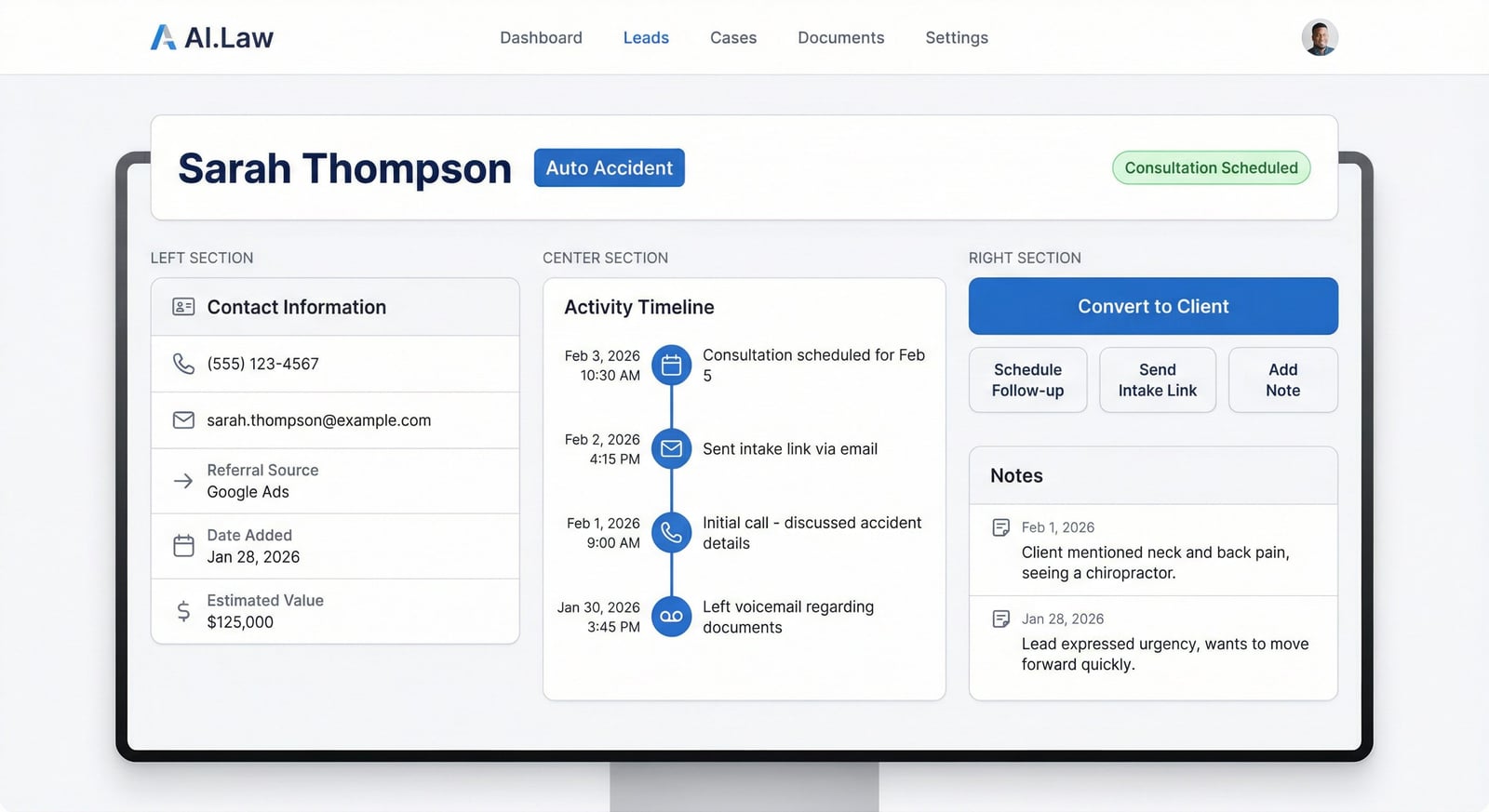
Not a mockup — this is the actual AI.Law workspace attorneys use on live cases.
Real intake → real conflict answer
New business screen: Proposed client: Apex Manufacturing LLC · Adverse: Northstar Logistics Inc. · Matter: cargo loss · upload complaint PDF
Conflict Clear returns: Moderate match — Northstar Logistics was adverse party in Matter #2019-184 (2019). Substantial-relationship score: Moderate under Rule 1.9. Prior determination memo (3/2020) linked. Route to conflicts counsel — partner escalation recommended.
Entity extraction runs on uploaded complaints, OCGs, and K-1s — not just typed names.
Conflict checks & Rule 1.9 questions for conflicts counsel
How does AI.Law handle current-client adversity vs. former-client substantial relationship?
Direct adversity to any current client is flagged firmwide immediately, regardless of subject matter. Former-client hits receive a substantial-relationship analysis under ABA Model Rule 1.9 with a High / Moderate / Low score and plain-English rationale, plus links to prior determinations when the entity appeared before.
Can we screen before opening a client or matter record?
Yes. Paste proposed parties or upload a complaint, engagement letter, or outside-counsel guidelines. AI extracts entities automatically and screens against current clients, former matters, affiliates, insurers, experts, and the historical conflict repository — without creating a matter first.
Does the system replace the conflicts attorney's judgment?
No. AI sources, ranks, and summarizes potential conflicts; a human makes the decision. Every data point behind a recommendation is one click away for validation, and exportable Word conflict memoranda document the call for partners.
More Detail
Conflict intelligence, not name search
Legacy conflict check software returns 300 name hits and leaves your team to sort the relevant from the noise. AI.Law is different: it scores how strong each match is, classifies the relationship — current client, former client, affiliate, parent, subsidiary, insurer, expert, witness, beneficial owner, prior adverse party — and tells you which matches actually warrant review. Current-client adversity is flagged immediately, regardless of subject matter, and former-client matches get a substantial-relationship analysis under ABA Model Rule 1.9 with a plain-English rationale. Human in the loop, always: AI sources, distills, and summarizes the potential conflicts, but a human makes the decision — and every input behind a recommendation is one click from validation. AI.Law combines AI with deterministic non-AI processes so results are grounded in your firm's own records and avoid hallucinations altogether.
- Current client adversity alerts — direct adversity to a current client is flagged firmwide, instantly
- Substantial relationship analysis for former clients — AI scores High / Moderate / Low under Rule 1.9 with reasoning
- Entity match strength + relationship type on every hit — stop reviewing 300 undifferentiated name results
- Upload outside counsel guidelines (OCG), K-1 filings, complaints, and corporate disclosures — AI extracts every name and entity automatically so nothing is missed
- Human in the loop: AI sources, distills, and summarizes potential conflicts — the decision is the lawyer’s, and every data point the AI used is clickable for immediate validation
- AI plus non-AI processes eliminate hallucinations — every entity, match, and citation is grounded in your firm’s records, never invented
- Outside counsel guideline review — adversity restrictions, waivers, and carve-outs surfaced with the match
- Screens clients, affiliates, parents, subsidiaries, insurers, experts, witnesses, and beneficial owners across every matter
- Fuzzy matching catches abbreviations, aliases, and pre-deduplication name variants
Faster
Stop reviewing 300 name hits — find relevant conflicts faster
Manual conflict search means reading every name hit against every matter and deciding relevance from memory. AI conflict intelligence ranks results by real risk, groups them by concern, and surfaces the supporting documents — so conflicts counsel reach a defensible answer in minutes, not hours, and partners are interrupted only for issues that genuinely need them.
- Results grouped by concern — current-client, former-client / substantial-relationship, related-entity, and low-relevance
- Reduce partner interruptions: escalate only meaningful conflicts, with a routing recommendation on every hit
- Source documents linked to each match — open the matter, engagement letter, OCG, or prior memo behind the answer
- AI-powered new business intake — paste a proposed client and adverse parties, or upload the complaint, and screen firmwide
Easier
Your firm already solved this conflict once
Every conflict decision your firm has ever made is institutional knowledge that usually walks out the door when a conflicts attorney leaves. AI.Law's historical conflict intelligence preserves it: prior conflict memoranda, determinations, engagement terms, and waivers are stored, semantically searchable, and resurfaced automatically when a related entity comes up again — so your team reuses prior conflict decisions instead of re-deciding them.
- Reuse prior conflict decisions — a matching entity resurfaces the firm's earlier memo and determination
- Historical conflict intelligence: a searchable repository of memos, determinations, engagement letters, OCGs, and waivers
- Continuous conflict monitoring — when a new party is added to any matter, the conflicts team is alerted automatically
- AI conflict memoranda: export a reviewer-ready Word memo for partners in one click
More Money
Reduce partner interruptions — the most expensive minute in the firm
The biggest cost in conflicts is not the search; it is interrupting a rainmaker to answer a question a conflicts attorney could resolve with the right context. AI.Law gives conflicts teams that context up front, so partners are pulled in only when an issue truly requires them. Basic conflict screening is free on every AI.Law plan with a complete audit trail. Conflict Intelligence — AI substantial-relationship analysis, the historical repository, continuous monitoring, and conflict memoranda — is a robust enterprise tier built for law firms with more than 500 lawyers and the conflicts professionals, COOs, and chief risk officers who run them.
- Reduce partner interruptions by escalating only meaningful conflict issues
- Free basic conflict screening on every plan — automatic, firmwide, fully audited
- Enterprise Conflict Intelligence for firms with 500+ lawyers — substantial-relationship analysis + reusable prior determinations
- Eliminate disqualification, malpractice, and bar-discipline risk from undetected conflicts of interest
Conflict intelligence vs. another name search
See what changes when AI handles the work instead.
| Area | The Old Way | With AI.Law |
|---|---|---|
| Result quality | 300 undifferentiated name hits to sort by hand | Ranked by match strength and relationship type — relevant conflicts first |
| Current-client adversity | Caught only if a reviewer connects the dots | Flagged firmwide instantly, regardless of subject matter |
| Substantial relationship | A partner reads two files and decides from memory | AI scores it under Rule 1.9 and resurfaces prior determinations |
| Institutional memory | Walks out the door when a conflicts attorney leaves | Prior memos and decisions are reused automatically |
| Partner time | Rainmakers interrupted for routine questions | Only meaningful issues escalate — fewer partner interruptions |
| Cost | Legacy conflict software priced per seat, per year | Basic free on every plan; enterprise Conflict Intelligence for 500+ lawyer firms |
Related tools for Conflict Checks
Same matter file, same uploads — keep working in this litigation workflow cluster.
- Screen conflicts at lead entry before partner time is spent — Lead CRM
- Send intake only after conflicts counsel clears the matter — Client Intake
- Search prior matters and entities across the entire firm — Cross-Matter Intelligence
- Control who sees conflict results with role-based access — Permissions & Roles
Browse all Intake & CRM tools on the features hub, or see all features.
SOC 2 Type II Certified · Patented Technology · No AI Training on Your Data · You Own Your Data
Explore More
AI gathers your clients’ core information in a natural chat — until your firm has exactly what it needs
AI.Law’s Automated AI Intake interviews clients in a natural, chat-based conversation — in English or Spanish, around the clock — asking adaptive follow-up questions until every piece of information your firm requires has been gathered. Clients answer in their own words at their own pace and upload documents directly in the chat — photos, police reports, medical bills, insurance cards — all processed and attached to the matter automatically. By the time your team opens the report, the facts are organized, the documents are in, and the conflict check is done.
Get started with Conflict Checks
Open an account to test our free conflict checks capabilities. Enterprises that need complete conflict clearing should schedule a demo.
No credit card required.
Need a firm or enterprise plan? Talk to our team